


WHEN SOMEONE THEY LOVE HAS DIED — OR A LIFE THEY COUNTED ON HAS ENDED
Grief doesn’t shrink.
Life can grow around it.
Maybe it was a parent, a sibling, a grandparent who raised them, a friend who died far too young. Maybe it was a different kind of ending — a divorce, a diagnosis, a future that quietly fell through. Your son or daughter is carrying something heavy, and the world around them has already gone back to normal. We are mentors — steady adults who walk beside a grieving young person, week after week, while they find their footing again.
We don’t fix grief. We keep them company inside it — and help life keep moving.
A free 40-minute consultation call. No pressure, no obligation. If clinical grief care is what your family needs, we will say so and point you to the right people.
At this age, grief rarely looks like crying.
Losing someone at 16 or 22 is an “off-time” loss — meaning that almost no one around them has been through it, so there is no script and no company. Here is what it actually tends to look like:
None of this means something is wrong with them. It means something happened to them.
And not every loss is a funeral. A parents’ divorce, a family estrangement, a first real breakup, an injury that ends a sport, a future that fell through — these are real griefs too, even when nobody sends flowers.
Your family is not as alone as it feels.
1 in 12
Colorado kids will experience the death of a parent or sibling before they turn 18
2×
that number more than doubles by age 25
1 in 4
college students is grieving a death from the past twelve months
Sources: Judi’s House / JAG Institute, 2025 Childhood Bereavement Estimation Model; Balk, Death Studies.
The 5 Stages of Grief — and what comes after
You may know the five stages of grief — denial, anger, bargaining, depression, acceptance. There is real value in them: they give a family shared words for enormous feelings, and permission for the angry days and the numb ones alike. They are best held gently, though — as a map of emotions rather than a schedule. Real grief moves in waves and loops, in its own order, on its own clock, and nobody should feel they are grieving in the wrong order.
Alongside the stages, here is the picture we build our mentoring around — the way life grows around grief:
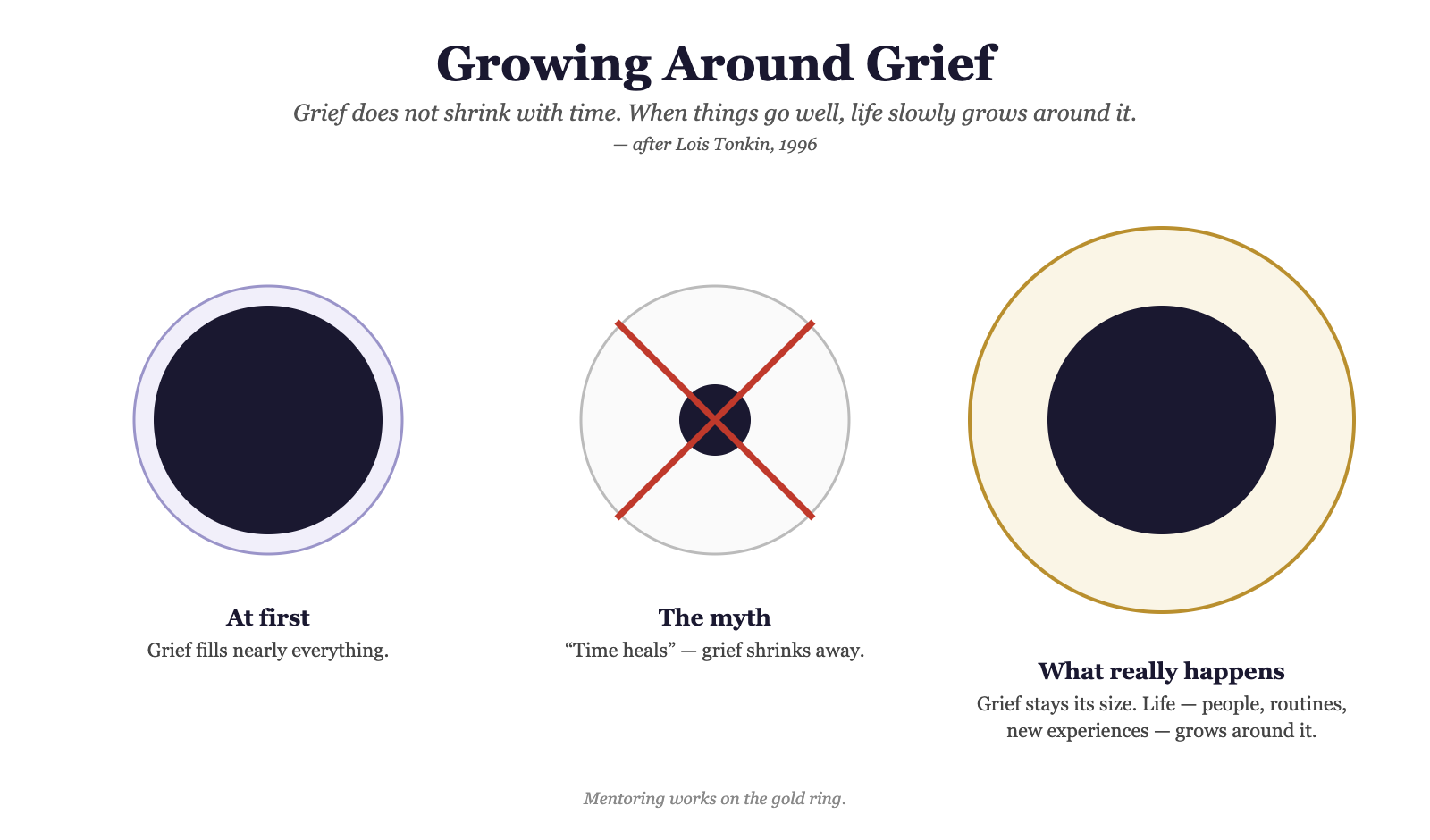
Nobody “moves on” from a person they loved — and they don’t have to. The work is growing a life big enough to hold the loss: new routines, new skills, new people, new mornings. That growing is exactly what mentoring is for.
HOW MENTORING HELPS
We walk beside.

Most of our best conversations happen sideways — over soil, trails, engines, and coffee.
“The single most common factor for children who develop resilience is at least one stable and committed relationship with a supportive adult.”
— Harvard Center on the Developing Child. That sentence is our whole job description.
What steadier actually looks like
Grief will not be gone by spring, and we will never pretend otherwise. Here is what real movement tends to look like:
There is no deadline on any of this. When it feels like time, the first conversation is free, 40 minutes, and carries no obligation at all.
From the blog