Mentor and young man walking side by side on a Colorado Front Range trail at golden hour

A Real Plan for School — and What Comes After

FOR STUDENTS, YOUNG ADULTS, AND THE PARENTS WATCHING THEM DRIFT

School that is going sideways. A future with no shape yet. Noble Mentors takes both seriously — with academic coaching that turns semesters around and career advising that finds a direction worth working toward.

Academic Advising ↓Career Coaching ↓

15+ years
of mentoring
300+
families served
2 Days
from your call to a first session

Every Noble mentor builds executive functioning, school skills, and career exploration into one-on-one mentoring — and every client also has access to our academic advising and career coaching specialist, Kristin Walker.

Serving Boulder, Denver, and the Colorado Front Range. Home office: Lafayette, Colorado.

A free 40-minute consultation call. No pressure, no obligation. If we are not the right fit, we will point you to who is.

One goal, two ways we deliver it

Your mentor, every week. Academic and career growth is not a separate program bolted onto mentoring — it runs through it. The same mentor who takes your son or daughter climbing also sits with them over a planner, builds study systems, drives them to a job interview, and holds the follow-through when motivation dips.

A specialist behind every mentor. Kristin Walker spent nine years as a university academic advisor at the University of Connecticut and CU Boulder, where she created and ran an academic coaching program for students in exactly the situations our families know well — slipping grades, stalled motivation, leaves of absence, and the fog of not knowing what comes next. At Noble Mentors she works across all of our clients: guiding strategy with each mentor, and meeting directly with students and young adults who need the deeper academic or career work.

Her approach, in her own words, is relational first: getting to know the specifics of each clients strengths and weaknesses, then practical strategies and manageable steps toward the goals that the mentee actually cares about.

Meet Kristin and the team →

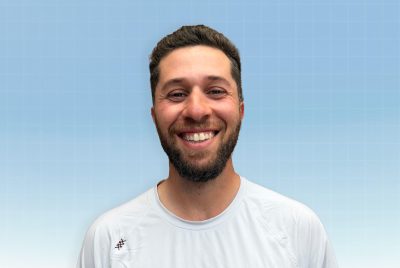
Kristin Walker — academic advising and career coaching specialist at Noble Mentors

Kristin Walker
Academic Advising and Career Coaching Specialist
Noble Mentors

TRACK ONE · ACADEMIC COACHING

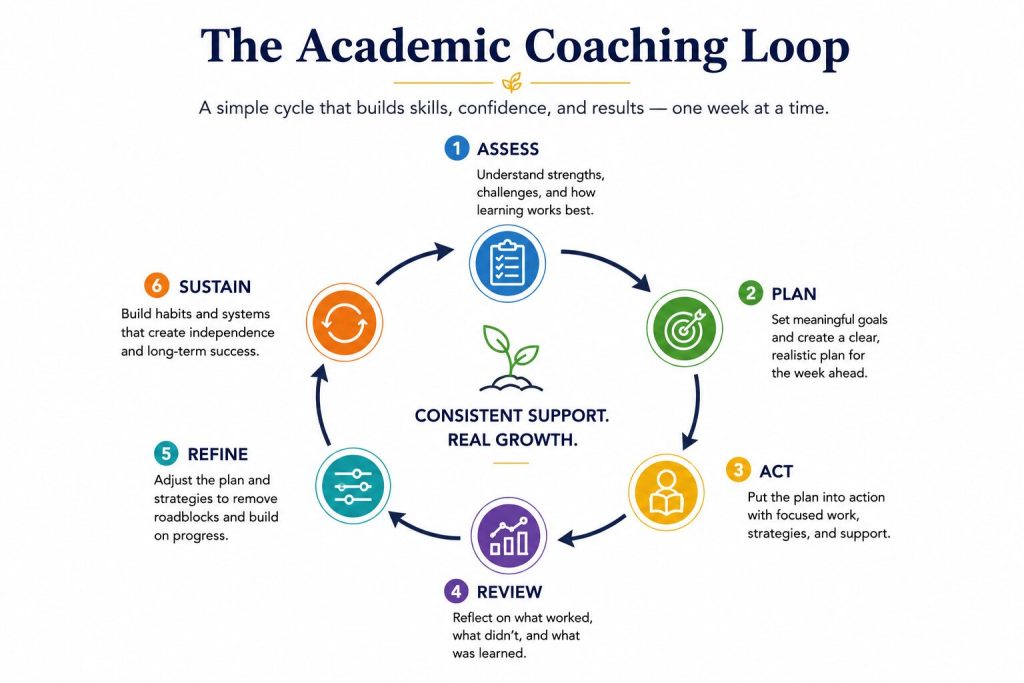
Academic coaching that rebuilds the semester

Not tutoring. Tutoring re-teaches Tuesday’s chemistry. Coaching rebuilds the system underneath — how a student plans, starts, studies, and recovers when a week goes wrong. In a randomized Stanford study of 13,500 students, this kind of one-on-one coaching lifted persistence in school by 15 percent .

Mentor and student reviewing a planner together

A weekly planning session — one planner, one honest system, built together.

Study systems and test preparation

Most struggling students have never been taught how to study — they reread, highlight, and hope. We replace hope with method.

What we actually teach
Evidence-backed techniques: spaced practice instead of cramming, retrieval practice (self-testing) instead of rereading, breaking big assignments into scheduled pieces, and building a test-prep runway that starts ten days out, not the night before. Each technique is practiced together in real coursework, not explained in the abstract.
What changes
Less all-nighter panic, fewer blown deadlines, and grades that reflect ability instead of chaos. The goal is a repeatable system the student runs without us.

Time management and executive functioning

For many of our students — especially those with ADHD or executive functioning challenges — the problem is not caring. It is starting.

What we actually do
One planning system (paper or digital — whichever he or she will really use), a weekly planning ritual with their mentor, task breakdowns that shrink “write the essay” into steps that can begin today. We build external structure first, then work through the tasks step by step.
Where Kristin comes in
This is the heart of the academic coaching program Kristin built and ran at CU Boulder — helping students develop executive functioning skills, motivation, and accountability that hold up under a real course load.

Goals, motivation, and values

Accountability without meaning quickly turns into nagging. We begin by understanding what the student genuinely wants and connecting the work to what matters to them.

What we actually explore
We help the mentee clarify their values, motivations, and goals: What matters enough to work toward? From there, we turn their goals—in their own words—into practical weekly commitments, with a mentor providing structure, encouragement, and accountability. When motivation dips, we treat it as useful information rather than failure.
Why this holds
A mentee may abandon a plan imposed on them as soon as things get difficult. They are far more likely to stay committed to a plan they helped create. That is the difference between compliance and ownership.

Assessment of challenges and strengths

We begin with an honest picture — where the struggle actually lives, and what strengths we can build on.

What we look at
Study-strategy and learning inventories (tools in the LASSI family), executive functioning skill reviews, strengths inventories, and a plain conversation about the story so far: what has worked, what has not, what has never been tried. If results suggest something clinical — a learning difference, untreated ADHD, anxiety — we say so and help the client find the right professional support.
Re-engagement after setbacks
Failed semester, academic probation, a leave of absence — Kristin has guided many students back from exactly this: a realistic re-entry plan, reconnection with campus resources, and confidence rebuilt through small kept promises.

How the academic side runs, week to week

Schedule a free consultation call →

TRACK TWO · CAREER ADVISING

Career advising built on real contact, not just quizzes

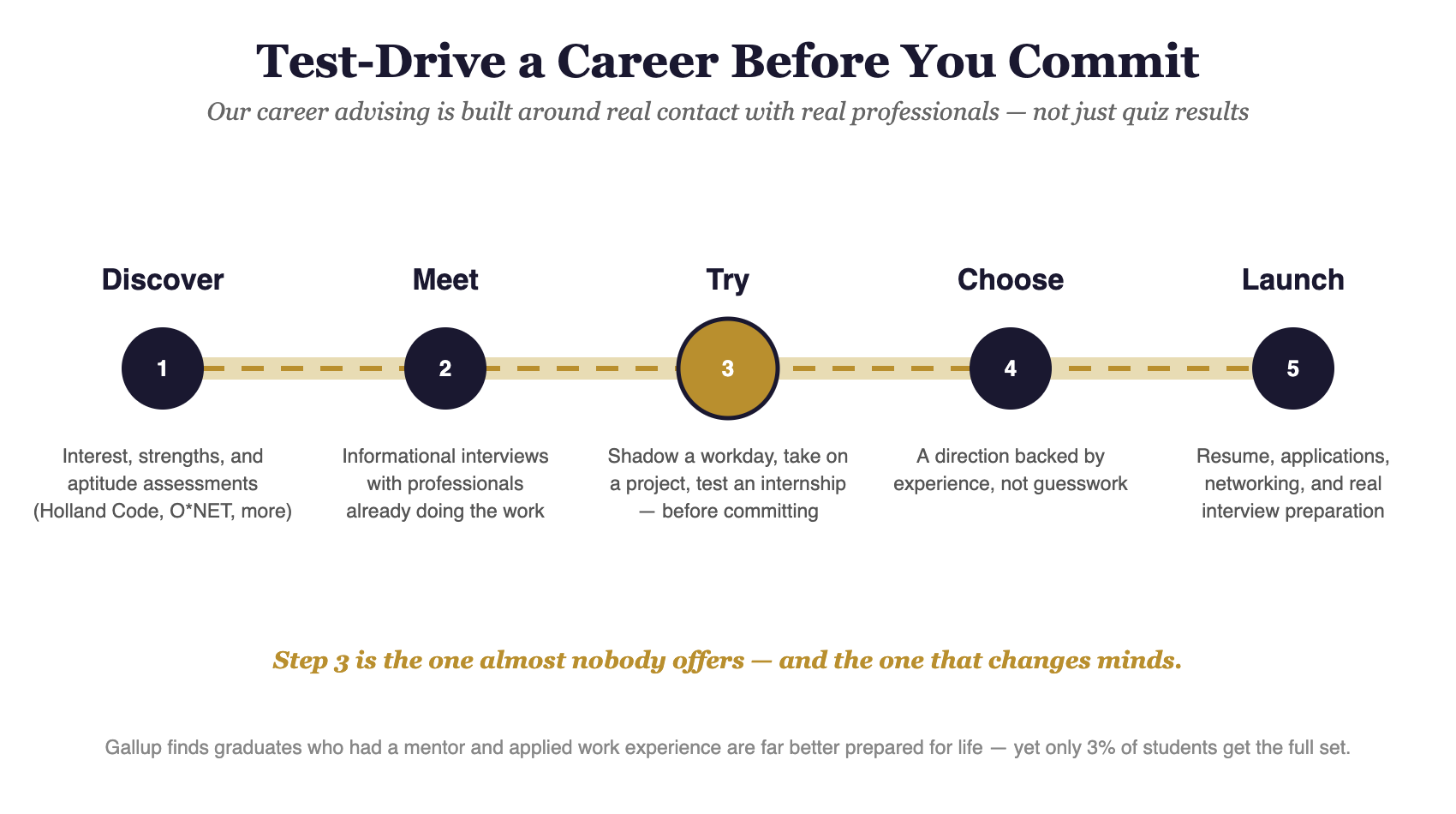
Gallup’s research on college graduates is blunt: the ones who had a mentor and real applied work experience are dramatically better prepared for life — and only about 3 percent of students get that full set of experiences. We build those experiences on purpose. Open each step.

1 · Career exploration and assessments
We start wide, with tools that surface interests, strengths, and aptitudes: the Holland Code (RIASEC) framework, the O*NET Interest Profiler, strengths inventories like CliftonStrengths, and aptitude-based tools such as YouScience. Results are conversation starters, not verdicts — the point is a shortlist of directions worth investigating, grounded in who this young person actually is.
2 · Meet the people already doing it
This is where our mentoring model earns its keep. We help clients find and reach professionals working in the fields on their shortlist — through our network and their own — and prepare them to run real informational interviews: what to ask, how to listen, how to follow up. A twenty-minute conversation with someone living the career teaches more than a hundred browser tabs.
3 · Try the work before committing to it
Wherever possible, we go further than talking: a day of job shadowing, a small real project in the field, a part-time role or internship. Testing a career from the inside — before choosing a major, a certification, or a first job — is the single best protection against spending three years training for work he turns out to hate.
4 · Resumes, applications, and materials
When direction firms up, we build the materials: a resume that tells a compelling story, applications, portfolios or work samples where they matter, and a LinkedIn presence. All of it done with the mentee, so they can maintain it themselves.
5 · Interview preparation
Mock interviews with honest feedback, practice answering the hard questions plainly, and the quieter skills — showing up on time, dressing right, following up, negotiating a start. Confidence here is built the same way as everywhere else: reps with someone in your corner.

Career advising roadmap: discover through assessments, meet professionals in informational interviews, try the work through shadowing or internships, choose a direction, launch with applications and interview prep

About the assessments we use

Good assessments start conversations. Bad ones end them. We use established tools on both tracks, and we never hand a young person a printout as if it were a verdict on his life.

On the academic track

Study-strategy and learning inventories (the LASSI family), executive functioning skill reviews, motivation and values exploration, and strengths inventories. Together they show where the struggle actually lives — skills, systems, motivation, or something deeper worth a professional look.

On the career track

The Holland Code (RIASEC) framework and O*NET Interest Profiler for interests, CliftonStrengths for strengths, and aptitude-based tools such as YouScience. Results build the shortlist — then informational interviews and try-it-first experiences test the shortlist against reality.

How it starts

1

You call

A free 40-minute conversation about school, direction, or both. Students and young adults are welcome to call for themselves.

2

We build the plan

Mentor match plus Kristin’s eyes on the academic and career strategy — one plan, tuned to the actual situation.

3

The work begins

First session within a couple of days. Planner on the table, real coursework, real career conversations — from week one.

We take a limited number of families at a time so mentors can go deep with each one. If we are full or not the right fit, we will tell you straight and point you somewhere good.

Schedule a free consultation call →

What this looks like in real life

The college student on academic probation:
After failing two classes and watching their GPA drop, the student and their family were preparing for the possibility of withdrawal. The mentor began by rebuilding the foundations of the week: consistent sleep, a simple planning ritual, and one study system the student could realistically maintain. At the same time, Kristin helped shape a re-entry plan and prepare for a productive conversation with the academic advisor. By the end of the following semester, the student was off probation and following a schedule they had learned to build and manage independently.

The 22-year-old who graduated without a clear direction:
After earning a diploma, moving home, and becoming increasingly stuck, the young adult had stopped applying for opportunities altogether. Career assessments narrowed the possibilities to three promising paths, and informational interviews quickly ruled one out. A month of job shadowing and a small paid project helped clarify the right direction. From there, the mentor supported the practical next steps: strengthening the résumé, submitting applications, and preparing for interviews. Eight months after the first session, the client began full-time work in a field they had chosen intentionally.

“Meaningful progress begins with building trust, listening deeply, and understanding each person’s strengths and obstacles. From there, we develop practical strategies, establish structure, and take manageable steps — until a young person recognizes his or her own capacity for growth.”

Kristin Walker — Academic Advising and Career Coaching, Noble Mentors

Mentor reviewing a planner with a young adult student during an academic coaching session in a library

One conversation can reset the direction of a whole semester.

If this is the semester things turn around, the free 40-minute consultation call is where it starts — no pressure, no obligation.

Questions families ask

Is this tutoring?
No. Tutors re-teach subject content, and when a student needs one we will say so and help you find one. Academic coaching works on the layer underneath — planning, starting, studying, follow-through — so improvement shows up across every class, not just one. The two work well together.
Who actually works with my student — a mentor or Kristin?
Both, in different ways. Your student’s mentor carries the week-to-week work: planning sessions, accountability, real-world career contact. Kristin works across all Noble Mentors clients as the specialist — shaping each academic and career strategy with the mentor, and meeting directly with students whose situation calls for her depth, like a return from academic leave or a full career search. If a client comes in specifically looking for academic and career support, they might be paired with Kristin as their primary mentor, and she would hold both roles in this situation.
What if he has no idea what he wants to do?
That is the normal starting point, not a problem. Nobody finds direction by being asked “so what do you want to do?” one more time. Assessments open the field, conversations with real professionals narrow it, and trying the work settles it. Direction is discovered by doing — we build the doing.
He failed out / is on academic leave. Can you help him go back?
Yes — this is a specialty. Kristin spent years at universities helping students return from leaves of absence and academic setbacks: realistic re-entry plans, honest course loads, reconnection with campus resources, and the confidence rebuilding that has to come with all of it. The comeback semester is planned, not improvised.
What happens on the free consultation call?
Forty minutes with us, no cost and no obligation. You tell us what is happening — the transcript, the stalled job search, the drift. We tell you honestly whether we are the right fit, and if we are not, we will point you to who is. If we are, the first session usually happens within a couple of days.

Schedule a free consultation call →

A plan for school. A path to a career. One call to start both.

A free 40-minute consultation call. No pressure, no obligation. If we are not the right fit, we will point you to who is.