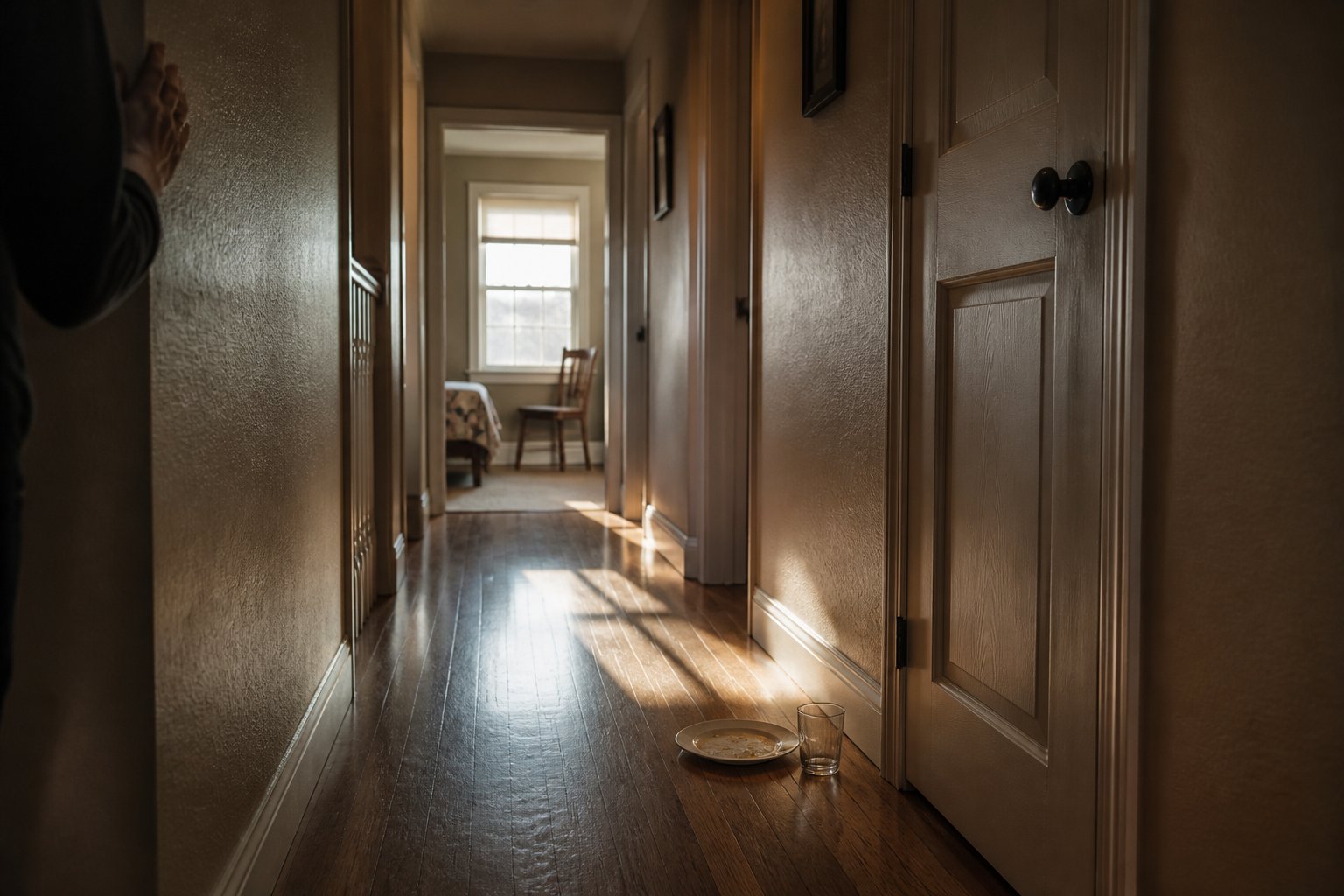
Your son’s door has been closed since spring. You hear him at 2 a.m., the microwave, the bathroom, the soft click of the latch, and by the time you leave for work he is asleep again. No job, no classes, no friends who come by. Somewhere around month four you typed “American hikikomori” into a search bar, read a few paragraphs, and felt your stomach drop, because the description was your kid.
The word is Japanese, and most of what you will find about it is about Japan. But American hikikomori is real, and the pattern is in houses along the Front Range. This post is for the parent who has just found the word and needs to know what it means, what it does not, and what has actually helped families get someone back out.
What hikikomori means, and what it does not
Hikikomori (hee-kee-ko-MO-ree) is a Japanese word for pulling inward. It came to describe young people who withdrew into their homes, often into a single room, for six months or longer, without school, work, or in-person friendships. It has been a national concern in Japan for more than two decades, counted in government surveys.
It is not a diagnosis. You will not find it in the DSM, and nobody at Noble Mentors will tell you your child “has” it. It describes a pattern: severe, long-lasting social withdrawal, usually beginning in the late teens or twenties, that the person cannot reverse on their own. That is the honest answer to “what is hikikomori.”
It is also not a Japanese curiosity. A 2015 study led by Alan Teo and Takahiro Kato looked for the pattern in four countries and identified 36 people with hikikomori across India, Japan, Korea, and the United States, with cases in all four. A 2019 review in Frontiers in Psychiatry notes reports from several European countries, India, and the US as well. Hikikomori in the United States often goes unrecognized because it goes by other names: failure to launch, depression, “he’s just going through something.”
Said plainly: your child is not broken. Withdrawal this deep is usually the most protective move a frightened, exhausted person could find. The way back has to feel safer than the room.
What an American hikikomori looks like at home
Here is how the pattern usually shows up in an American house.
1 Night became day
Awake when the house is asleep, asleep when the house is awake. Nighttime is when nobody asks questions and the kitchen is empty. The reversed schedule is often the first thing parents notice and the last thing that changes.
2 The door, the plate, the DoorDash bag
Food travels to the room and dishes travel back out, sometimes days later. Delivery bags show up in the hallway that nobody else ordered. The bedroom slowly becomes an apartment with no rent and no exit.
3 Contact, but only through a screen
Your child may talk for hours a night on a Discord server and not be able to make eye contact with you in the kitchen. Some researchers now count a person as withdrawn even when they stay connected online. It is real contact, and it is also a way to stay hidden.
4 A launch that failed, then went quiet
Look back and there is usually a threshold that did not hold: a first semester away that ended early, a job that lasted three weeks, a friend group that moved on. The room came after. Shame is the engine far more often than laziness, and shame is quiet.
Hikikomori vs. NEET: why the difference matters
You will run into the term NEET, “not in education, employment, or training.” Plenty of 22-year-olds are NEET for a season. They are between jobs, they still see friends, they leave the house. That is not hikikomori.
Hikikomori is about withdrawal, not employment. A person can work remotely from their bedroom and still be withdrawn to a degree that is hurting them. The question is not “are they working” but “are they in the world.”
The distinction changes what you do. A NEET young adult often needs structure and a push on the job search. An American hikikomori who gets that push usually withdraws further, because the job search is exactly the terrain where they last got hurt.
What hikikomori is usually tangled with
Hikikomori almost never travels alone. The Frontiers review found that a large majority of help-seeking hikikomori met criteria for a psychiatric diagnosis, most often social anxiety, depression, or avoidant personality disorder. Autism overlaps often enough that a good evaluation should ask about it. Gaming and internet overuse are so intertwined with withdrawal that it is often impossible to say which came first.
Depression deserves its own sentence. The National Institute of Mental Health describes it as a condition that changes how a person sleeps, eats, and works, and it is treatable. In young adults it often looks like flatness rather than sadness; see what depression looks like in young adults. If the room came after a slow fade of energy and interest, depression is the first thing to rule out with a clinician.
Then there is shame, not a diagnosis but often the glue holding everything else together. A young adult who believes they have already failed at being an adult does not want to be seen trying again. That is why young adults pull away hardest from the people who love them most.
The room is not the problem. The room is the solution your child found to a problem they could not name, usually some mix of fear, shame, and exhaustion. Nobody leaves a solution until they have a better one. The work is not to make the room unbearable but to make the world outside it feel possible again, one small doorway at a time.
What parents try that tends to backfire
You have probably tried most of these, because you were scared. That is not a failing. It is worth knowing why they tend not to work.
The ultimatum. “Job by the first of the month or you’re out.” A deadline lands on a person with no path to meet it, and the room gets deeper.
Cutting the cord. Taking the router, the door, the console. For a young adult whose only human contact runs through that screen, this is not removing a distraction. It is cutting the last thread.
Pretending it is fine. This is the kindest mistake and the most common. You bring the plate, you stop asking, you tell relatives he is taking a gap year. Months become a year.
Waiting for them to want help. Motivation does not usually arrive first. It shows up after a small experience of things going better.
What has actually helped families get someone back out
In Japan, where families have dealt with this longest, the approaches that took hold were not dramatic. The Frontiers review describes home visits, befriending, and parent support groups, and recommends a combination rather than any single hikikomori treatment. That matches what we have seen in Colorado houses.
It starts with outreach that asks for nothing. A non-family adult comes to the house, not to get your son out of his room, but to sit in the kitchen, play the game he plays, or talk through the door. The first visits may look like nothing happened. Something did: a person showed up, made no demands, and came back.
Then the doorway widens. A walk to the mailbox. The car, engine running, no destination. A coffee shop at 7 a.m. when nobody is there. Each step is small enough to succeed, because success is what motivation is made of.
Alongside that, the clinical piece gets addressed. If depression, anxiety, or autism is in the picture, a therapist or psychiatrist needs to be involved, and whoever visits the house coordinates with them. The Teo and Kato study found that most people identified wanted treatment and preferred face-to-face help. The willingness is often there, under the fear.
For some families the honest answer is more than a visit or two a week, and that is where in-home and live-in mentoring come in. It is also where failure to launch support and hikikomori help overlap. We wrote about the closed door itself in My Son Won’t Leave His Room; this post is about what to do once it has gone on for months.
What parents can do right now
Stop the negotiations for a week and just be around. Say good morning through the door and mean it. Rule out the medical and clinical side with a primary care visit and a therapist who has seen severe withdrawal. Then find one adult outside the family who can visit without an agenda. You are changing the temperature of the house so that leaving the room stops feeling like walking into a courtroom.
How Noble Mentors helps with hikikomori-style withdrawal
We are the non-family adult who comes to the house. Our mentors are not therapists and do not treat depression or anxiety; that is a clinician’s work, and every case is guided in consultation with our Clinical Director, Joseph DeNicholas, LCSW. We show up, build a real relationship on your young adult’s terms, and walk alongside them into the world at the pace they can handle.
For a young adult withdrawn for months, that usually begins with in-home sessions and no expectation of leaving the house. When more is needed, our live-in mentoring places a trained, supervised mentor in the home so that rebuilding sleep, meals, movement, and human contact happens where life actually happens. A mentor like Andrew Walsh, who works with mindfulness, healthy routines, and habits, is suited to this slow, patient kind of work.
Mentoring cannot make someone open a door they are not ready to open, and it cannot replace treatment for depression or anything else that needs a clinician. If your child has talked about not wanting to be here, that is an emergency, not a mentoring question; call or text 988. Sometimes we will say a higher level of care is the right first step.
Questions parents ask about American hikikomori
Is hikikomori a real condition in the United States?
Yes. American hikikomori has been documented, including in a four-country study that identified cases in the US alongside Japan, Korea, and India. It is not a formal diagnosis in any country. American clinicians usually describe it through the conditions tangled up with it: social anxiety, depression, or autism, often with gaming. The word helps parents recognize the pattern; an evaluation still needs to happen.
What is the difference between hikikomori and NEET?
NEET describes a status: not in education, employment, or training. Hikikomori describes withdrawal from social life, usually for six months or more. Many NEET young adults still see friends and leave the house. A hikikomori young adult may or may not be working, but they are not in the world.
How do you treat hikikomori?
There is no single hikikomori treatment. Research from Japan and elsewhere describes a combination: treating any underlying depression or anxiety, home visits from a non-family adult, support for the parents, and a gradual return to life outside the home. What works is slow, relational, and coordinated between clinicians and whoever is showing up at the house.
How do I get my young adult to leave their room?
Usually not by making them. Start with contact that asks for nothing, rule out medical and clinical causes, and bring in one adult outside the family who can build trust without an agenda. Then make the first step outside so small it cannot fail. The door opens from the inside, once the outside feels safer than it does now. Withdrawal is a season, not a sentence.
If any of this sounds like your house, schedule a free 40-minute consultation and we’ll talk it through. If we’re not the right fit, we’ll point you to who is.
Serving Colorado’s Front Range
If your young adult has not left their room in months, our mentors come to the house first, and live-in support is available when a few hours a week is not enough. We coordinate with your child’s therapist or psychiatrist rather than working around them.
We work with families in Denver, Arvada, and across the Boulder to Denver corridor, in person. Parent coaching and much of our mentoring are also available virtually anywhere in the country.
Based in Lafayette, CO. Schedule a free 40-minute consultation to talk through what support could look like for your family.
About the Author
James Farmer
James Farmer is the founder of Noble Mentors, a therapeutic mentoring organization along Colorado’s Front Range. With over 15 years of experience mentoring teens and young adults through pivotal transitions, James trains and supervises a team of mentors committed to transformation through genuine relationship. He believes that real growth happens not in an office, but in the actual terrain of a young person’s life.
Read next
Life Skills Checklist for Young Adults (With a Printable PDF)
Once the door is open, this is the plain list of what a young adult needs to be able to do, and how to work through it without a fight.