

Helping capable young adults turn intention into action.
Your young adult may be intelligent, creative, and full of potential—and still struggle to organize their day, follow through on commitments, manage school or work, and build momentum toward independence. Noble Mentors provides practical, relationship-based ADHD support in the places where life actually happens. Mentors help young adults create workable routines, strengthen executive-functioning skills, and follow through on the goals that matter to them.
Not more advice. Consistent support, real-world practice, and systems that fit the way their brain works.
A free 40-minute consultation call. No pressure, no obligation. If we are not the right fit, we will point you to who is.
Does this look like your kitchen table?
“I know what to do.
Why can’t I just do it?”
If that question lives in your house, this page was written for you.
The prescription worked. Nothing much changed.
For many young adults, medication genuinely helps — it can quiet the static and sharpen focus. But a pill cannot choose what to focus on. It does not open the mail, make the phone call, or build the habit of sleeping before 3 a.m. Medication changes brain chemistry for a few hours; it does not build a life.
Therapy matters too — ADHD rarely travels alone, and the inner work is real work. But insight gained on Wednesday afternoon has a way of dissolving by Thursday morning, when the task is sitting there and no one else is in the room.
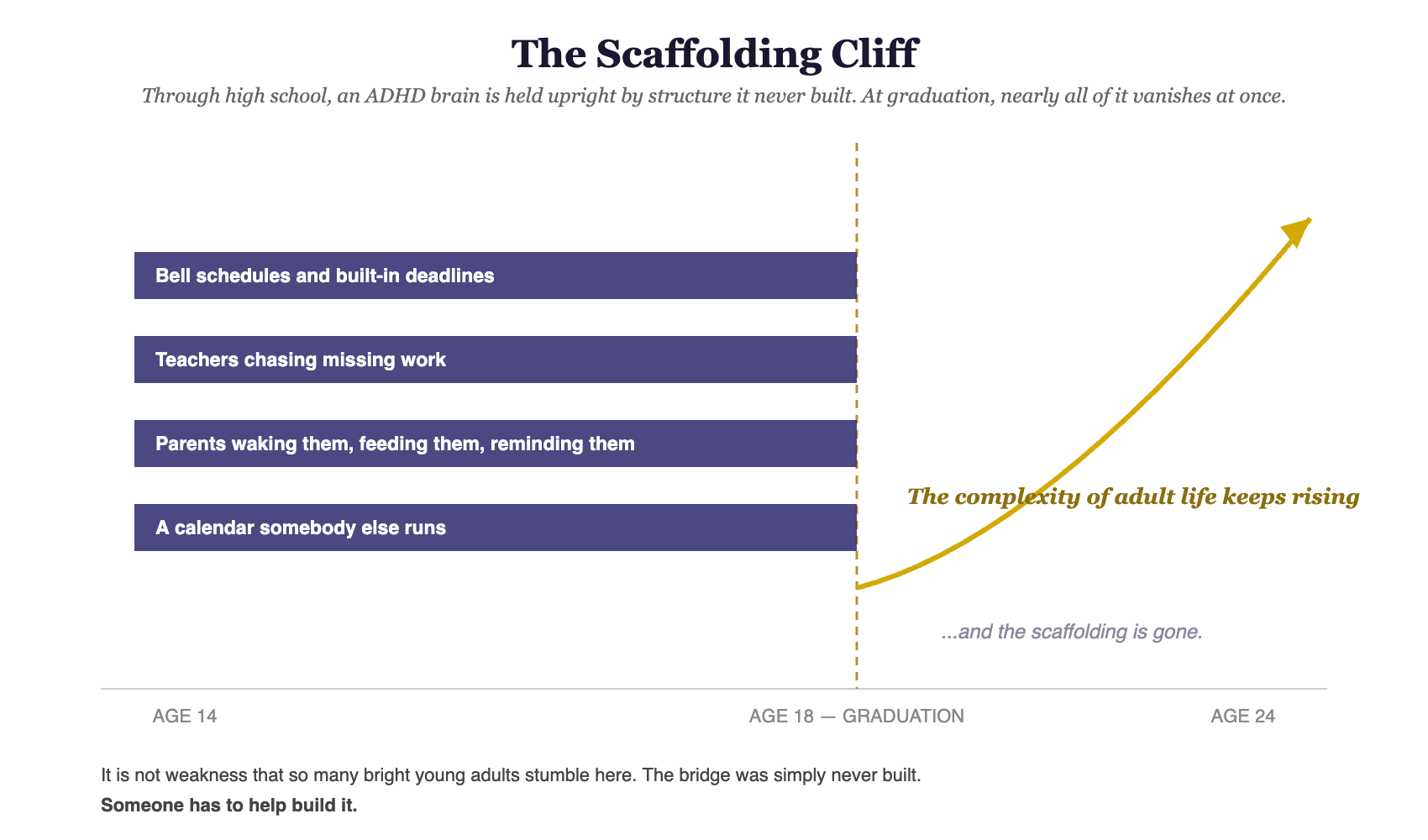
And then there is the scaffolding problem:
HOW IT STARTS
Three steps to momentum
1
You call
A free 40-minute conversation about what is actually going on — no pressure, no obligation.
2
We match
The right mentor for your son or daughter — someone who gets the ADHD brain. First session within days.
3
Momentum begins
Real sessions in real life — first small wins, then rhythms that hold.
HOW MENTORING WORKS
We sit beside, not across.
A Noble mentor does not sit across a desk once a week and ask how things went. We sit beside — at the kitchen table while the financial aid form finally gets finished, in the car on the way to the DMV, at the coffee shop while a resume takes shape. People with ADHD often work best in the presence of another person; some call it body-doubling. We call it not doing hard things alone.

Body-doubling in the wild: the financial aid form, finally finished.
THIS ENGINE RUNS ON
INTERESTNOVELTYMOVEMENTFRIENDLY URGENCY
We also stay in step with the people already in your corner — therapists, prescribers, professors, and parents. Mentoring is not therapy and not medical treatment; it is the practical, relational thread that helps those supports take hold in daily life. And when planning, memory, and follow-through are the deepest struggle, our executive function coaching goes further into that territory.
What progress actually looks like
We will not promise transformation by autumn. Here is what real movement tends to look like:
Small things, you might say. But a life is made of small things done again and again — and that is exactly where ADHD has been winning. It is also where it can be met.

Movement is a fuel — some of the best sessions happen mid-stride.
Where families and professionals find us
From the blog