
Executive Functioning Support

Mentor and young adult planning together at a table
When Intention Outpaces Action

Executive functioning struggles can be easy to misunderstand from the outside.

What looks like laziness, lack of motivation, avoidance, or defiance is often something more complex. A young person may genuinely want to do better, follow through, stay organized, or move their life forward—yet still find themselves overwhelmed by simple tasks, stuck in inconsistent patterns, and unable to turn intention into action.

This is one of the places where mentoring can make a real difference.

REAL FAMILIES. REAL FOLLOW-THROUGH.

What families say about working with us

Rated 5.0 on Google across 21 reviews · 300+ families served over 15 years

★★★★★

“Having someone to encourage me and walk along side me made a massive difference when talk therapy appointments felt so separated from daily life. A mentor was there to push (and drag) me towards the actions I needed to take.”

Casey G. · Google review ↗

★★★★★

“They’ve been a steady, positive support. They meet them where they are and helped us with emotional support, academics, and practical life skills — especially when we needed it most.”

Dawn M. · Google review ↗

★★★★★

“I often still use things I learned from him today that help me through interviews when needed or with jobs I had or have. I can’t put into words how appreciative I am to his help as a mentor.”

August G. · Google review ↗

What Are Executive Functioning Struggles?

Executive functioning refers to a set of mental processes that help a person manage themselves in a goal-directed way. When these processes are under strain, the issue is rarely simple laziness or lack of intelligence.

Core Function

Working Memory

Holding and using information in mind while completing a task. When this is weak, instructions get lost, context drops out, and multi-step tasks fall apart.

Core Function

Inhibitory Control

Pausing, resisting impulses, and staying on task. Weakness here shows up as impulsivity, distraction, and difficulty stopping one thing to start another.

Core Function

Cognitive Flexibility

Shifting attention, adapting, and adjusting when circumstances change. Rigidity, meltdowns at transitions, and shutdown under uncertainty all live here.

Executive functioning difficulties are commonly associated with ADHD—but they also show up in anxiety, depression, trauma, and other developmental or mental health challenges. Stress, poor sleep, loneliness, and low physical health can worsen them significantly. In daily life, they often appear as chronic disorganization, procrastination, emotional reactivity, forgetfulness, and difficulty turning intention into consistent action.

What Do These Struggles Look Like?

Executive functioning challenges rarely show up in just one area. They tend to ripple through a young person’s whole life. You may be seeing:

⏸

Trouble starting tasks, even when they matter

🗺

Difficulty planning ahead or breaking large tasks down

⏰

Losing track of time, deadlines, and commitments

📂

Chronic disorganization in school, work, or daily life

🌊

Emotional flooding that derails follow-through

🔒

Avoidance, procrastination, or shutdown under pressure

🔄

Inconsistency with routines, sleep, hygiene, or work

↩️

A pattern of promising change, then falling back into the same cycle

Sometimes this is connected to ADHD, anxiety, depression, trauma, technology overuse, or a broader failure-to-launch pattern. Sometimes it is not. Either way, the result is often the same: a young person who feels behind in life, and a family that is exhausted from trying to help.
0
Years of mentoring experience
0+
Families served
0
Days from your call to a first session
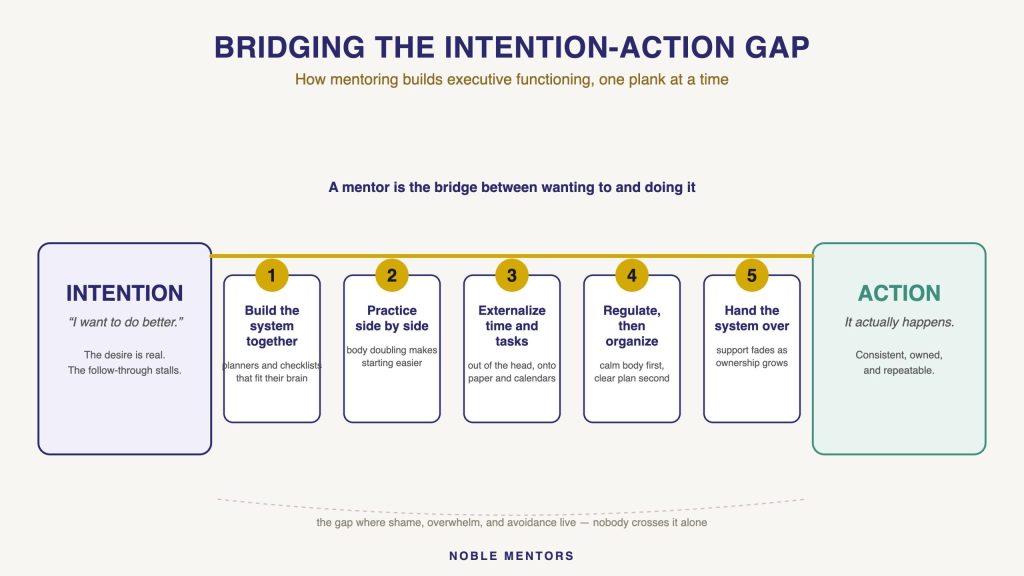
Infographic: bridging the intention-action gap - five ways mentoring builds executive functioning, from building the system together to handing the system over

How Noble Mentors Helps

Our mentoring is not just about productivity. We are not here to hover over a checklist or become another external control system. We are here to help a young person gradually build the capacity to organize themselves, regulate themselves, and participate in life with more consistency and ownership.

Depending on the client, our work may include:

  • Building simple, realistic routines that can actually be sustained
  • Creating structure around school, work, sleep, exercise, and responsibilities
  • Breaking overwhelming goals into concrete next steps
  • Strengthening follow-through and personal accountability
  • Helping clients manage avoidance, overwhelm, and emotional reactivity
  • Working through the discouragement and shame that builds around repeated failure
  • Developing life skills that support healthy independence
  • Helping the client reconnect to a larger vision for their life so structure has meaning behind it

Mentor and young adult planning together at a table

What Growth Often Looks Like

Growth in this kind of work is usually not instant. It often begins with small but meaningful changes.

A young person starts showing up more consistently. Their room stays cleaner. They begin following through on commitments. Their nervous system becomes less reactive. They communicate more clearly. They recover faster when they get off track. They begin to trust themselves more.

Not perfection. Capacity.

A young person who once felt scattered, avoidant, or dependent begins to develop real confidence—not the confidence of image, but the confidence that comes from becoming someone who can meet life more steadily.

Is This the Right Fit?

If your child is struggling with executive functioning and it feels like the same patterns keep repeating, you are not alone.

And your child is not broken.

Sometimes what is needed is not more pressure, but the right kind of support: relational, practical, steady, and developmentally attuned. That is what we aim to provide.

Questions parents ask about executive function coaching

Straight answers to the questions we hear most on the first call. If yours is not here, ask us on a free 40-minute call.

An executive function coach helps a teen or young adult build the skills school assumes they already have: starting tasks, planning a week, keeping track of assignments, managing time, controlling impulses, and recovering when the plan falls apart. Good coaching is done in the young person’s real environment — at the desk where homework actually happens — not in an office once a week.

At Noble Mentors, executive function coaching is part of therapeutic mentoring at $125 an hour, and we bundle it into monthly options: about $1,000 a month for a weekly session, or $2,000 a month for two sessions a week with text and call support and care coordination between sessions. We customize the level of support to what the young person needs and what the family’s budget allows. The difference from an hourly coach is that the mentor also handles the rest of the young person’s life — sleep, screens, motivation — not just the planner.

Usually not. Coaching isn’t a medical service, so most insurance plans won’t reimburse it, and Noble Mentors doesn’t bill insurance. HSA and FSA funds generally can’t be used for mentoring either, though a few plans accept a doctor’s letter of medical necessity — ask your plan administrator. We offer sliding scale when finances are tight, and we customize the level of support to the case and the budget.

The 30% rule is Dr. Russell Barkley’s rule of thumb that a young person with ADHD is about 30% behind their peers in executive function maturity — so a 15-year-old may plan and self-regulate more like a 10- or 11-year-old. It’s why “just try harder” fails and why the skills have to be coached and scaffolded, not demanded.

A tutor teaches the subject. An ADHD coach and an executive function coach teach the how — planning, starting, finishing — and they overlap heavily; the ADHD label just says who the coach mostly works with. A therapeutic mentor does the executive function work inside a broader relationship, which matters when the real blocker isn’t the planner but the motivation, the anxiety, or the screen.

Yes. The part of the brain that runs executive function keeps developing into the mid-twenties, which is exactly why the teen and young adult years are the window. Skills improve fastest when they’re practiced in real situations with someone alongside, then handed over a piece at a time — which is how our mentors work.

Most families see the first changes — assignments tracked, a morning routine that holds — within four to eight weeks of weekly sessions. Making the skills stick without the coach usually takes a school semester or two. We taper on purpose: the goal is a young person who runs their own week, not one who depends on us to do it.

Listed with

Where students and families find us

Noble Mentors is listed in the directories college counseling centers and ADHD organizations use to refer students and families for executive function support.

ThrivingCampus / WellTrack Connect

The referral directory used by counseling centers at CU Boulder, CU Denver, and other campuses. If your student is in college, their counseling center can find us here. Noble Mentors is listed as an executive functioning coaching provider accepting clients.

CHADD Professional Directory

CHADD is the national ADHD organization. Noble Mentors is a CHADD Professional Member, listed under coaching services for children, adolescents, young adults, and parents.

From the blog

Related reading

Executive Function Coaching for Young Adults: What It Is and When It Helps

Bills, deadlines, and daily life between 18 and 28.

Executive Functioning Help for Teenage Boys: Why Bright Boys Fall Behind

What parents misread as laziness, and what genuinely helps.

Executive Function vs. Laziness: What Parents Get Wrong

The label you choose changes everything about how you respond.

THE TEAM

Mentors who meet them where they are

Meet the Full Team →

The Noble Mentoring Framework

A Map for the Mentoring Journey

Mentorship at Noble Mentors begins with Intention and Connection, descends into the valley of challenge and discovery through Action, and rises through Reflection toward Service and lasting Presence.

If you would like to explore whether Noble Mentors might be a good fit, we would be glad to connect.