
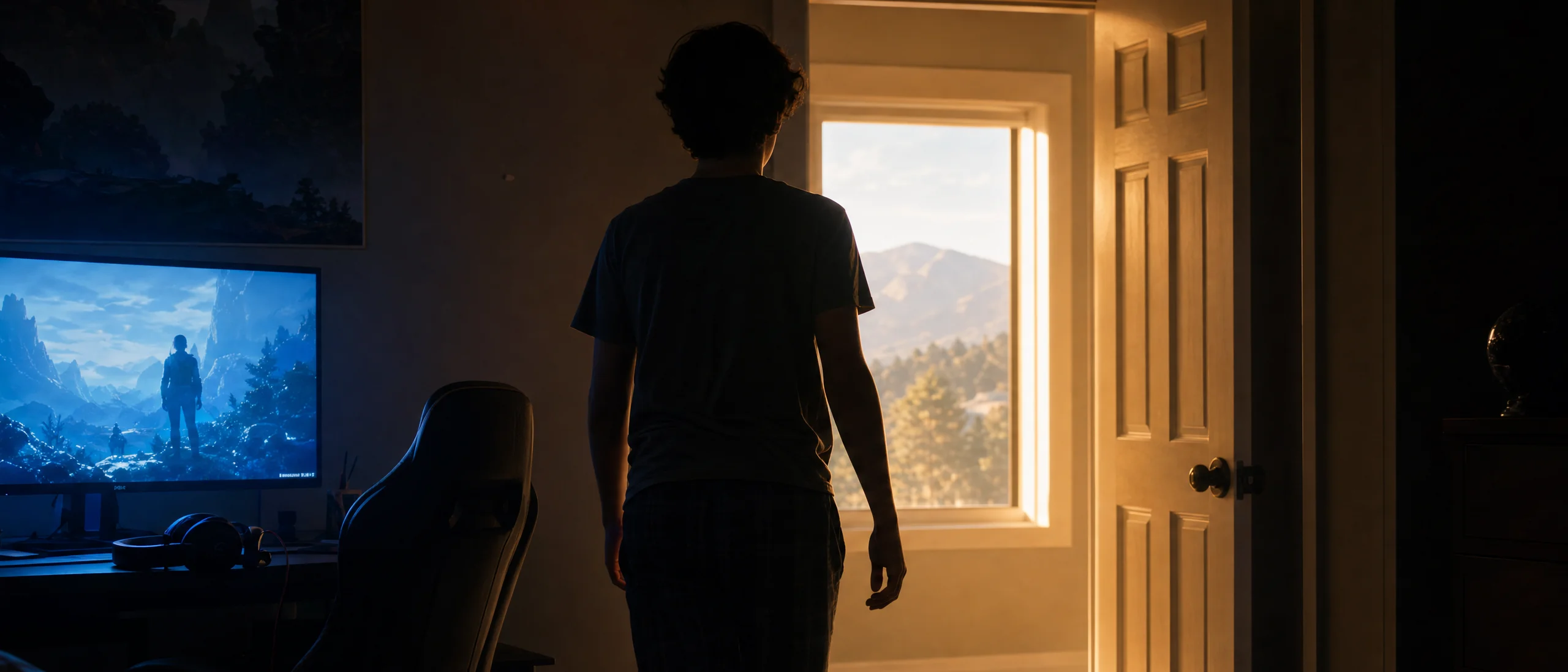
Thanksgiving break starts, school stops, and by Saturday your son hasn’t left his room. The headset stays on through dinner. When you mention a walk at Horsetooth or a drive to see family, you get a shrug or a fight. If you’re a parent in Fort Collins or Loveland, you’re not the only one dreading the next five weeks of breaks.
This guide covers what’s normal and what isn’t, what usually backfires, and the small things that work over a long break. It also covers where to turn in Northern Colorado if gaming has stopped being a hobby and started running your house. We say “he” below to keep it simple. Everything here applies to daughters too.
Why breaks make teen gaming worse
School gives a teenager a schedule they don’t have to build themselves. There’s a reason to get up, people to see, and a hard stop at bedtime most nights. A break takes all of that away at once. For a kid who already leans on games to handle boredom, stress or loneliness, the screen fills every empty hour.
The research backs up what parents see. A CDC report found that about half of U.S. teens (50.4%) spend four or more hours a day on screens, not counting schoolwork. Teens with that much screen time reported anxiety and depression symptoms at more than twice the rate of teens with less. That doesn’t prove screens cause the problem, but the two travel together.
The game is usually filling a need: connection, a sense of being good at something, or relief from stress. Take the game away without meeting the need, and the need wins.
Normal gaming or a real problem?
Lots of teens play a lot over a break and are fine. Hours alone don’t tell you much. What matters is what the gaming is pushing out of his life. The World Health Organization describes gaming disorder as a pattern of losing control over gaming, putting it ahead of other interests and daily life, and keeping going even when it causes real harm.
Here’s what Fort Collins parents usually notice first:
- He gets angry or panicky when the game ends, far more than the situation calls for.
- Sleep has flipped. He games until 3 a.m. and sleeps until noon.
- Friends he used to see in person have dropped away.
- Grades slipped well before the break started.
- He lies about how long he plays, or plays in secret after you’ve set limits.
- He has nothing else he likes doing anymore.
If you checked two or three of these, trust what you’re seeing. It doesn’t mean something is wrong with your kid. It means the game is doing a job something else used to do.
What usually backfires
Most of us reach for the router first. Unplugging everything on day one of a break almost always turns into a five-day standoff. Your teen learns the problem is you, not the habit. Yelling, sudden new rules and comparisons to siblings tend to end the same way.
Lecturing about brain science doesn’t work much better. He’s heard it. A teenager who already feels behind at school and with friends hears a lecture as one more way he’s falling short, and he goes back to the one place where he feels competent.
Five things that work over a long break
None of these will fix it overnight. Together they change the shape of the day.
1 Keep one anchor in the morning
Pick one fixed thing before noon: breakfast together, walking the dog, a ride to the store. One anchor keeps his sleep from drifting further every day.
2 Agree on limits before the break, not during a fight
Sit down when everyone is calm and set the plan together: when gaming happens, when it doesn’t, and what happens if the plan slips. Teens keep agreements they helped make far better than rules handed down mid-argument.
3 Get outside together, even briefly
Northern Colorado makes this easy. Twenty minutes on the Spring Creek Trail or a short loop at Horsetooth Mountain Open Space counts. Side by side, moving, with no eye contact required, is where a lot of teens finally talk.
4 Get curious about the game
Ask him to show you what he plays and what he’s good at. You’ll learn what need the game is meeting, and he’ll feel seen instead of judged. That makes every later conversation about limits easier.
5 Look at your own screen time
Kids notice. If phones stay off the table at meals and you take an evening offline yourself, your limits will sound fair instead of hypocritical.
What you can do this week
Choose one morning anchor and one outdoor plan for the long weekend. Tell him about both ahead of time, keep them small, and don’t attach a lecture to either one.
When it’s more than a rough break
If the break ends and the pattern doesn’t, or school was already sliding before Thanksgiving, it’s time for more support. You don’t need to wait for a crisis, and your teen doesn’t have to agree first. Many families start with a call of their own.
In Larimer County, CAYAC (Child, Adolescent and Young Adult Connections) helps families find mental health support for young people up through age 24. Call them at 970-221-3308. If your teen is in crisis, call or text 988, or reach SummitStone’s 24/7 line at 970-494-4200.
How Noble Mentors helps Fort Collins families with gaming and screens
Noble Mentors pairs teens and young adults with a mentor who meets them in person every week. Sessions happen out in the world: on a trail, at a coffee shop, at the climbing gym, wherever your teen actually spends time. The mentor’s job is to build the life that makes the game less necessary: real friendships, a routine that holds, and things he’s good at off the screen.
We work with ages 9 through 29 and with their parents. When it helps, we coordinate with a teen’s therapist, and parent coaching is available too. Read more about our gaming and screen support, or see how we work with families on our Fort Collins mentoring page.
Mentoring is not therapy, and it doesn’t replace treatment when treatment is needed. It’s the steady, real-world support that helps the rest of the work take hold.
Questions Fort Collins parents ask about teen gaming
How many hours of gaming is too many for a teenager?
There’s no single number. Watch what gaming is replacing. If sleep, school, friends and family time are holding steady, a long day of gaming over break is probably fine. If those are slipping, the hours are too many for your kid, whatever the total.
Should I take the console away?
Sometimes a reset helps, but taking it away suddenly, with no plan for what fills the time, usually leads to a standoff. Agree on limits ahead of time and put something real in the hours you take back.
What if my teen refuses to talk to anyone?
That’s common, and it’s not a dead end. He doesn’t have to be ready for you to start. A free call with us is for parents. We’ll talk through what you’re seeing and whether a mentor is a good fit, and the first meeting with a mentor is low-key and free.
Serving Fort Collins and Northern Colorado
Our mentors meet teens and young adults in person in Fort Collins, Loveland, Windsor and across Northern Colorado, as well as in Longmont, Boulder and the rest of the Front Range.
Every family starts with a free 40-minute consultation call. No pressure, no obligation.
About the Author
James Farmer
James Farmer is the founder of Noble Mentors, a therapeutic mentoring organization along Colorado’s Front Range. With over 15 years of experience mentoring teens and young adults through pivotal transitions, James trains and supervises a team of mentors committed to transformation through genuine relationship. He believes that real growth happens not in an office, but in the actual terrain of a young person’s life.
Read next
ADHD and Gaming Addiction: Why They Feed Each Other (and What Helps)
ADHD and gaming addiction feed each other. Here is why gaming grips ADHD teens harder, why the usual limits fail, and what actually helps.