
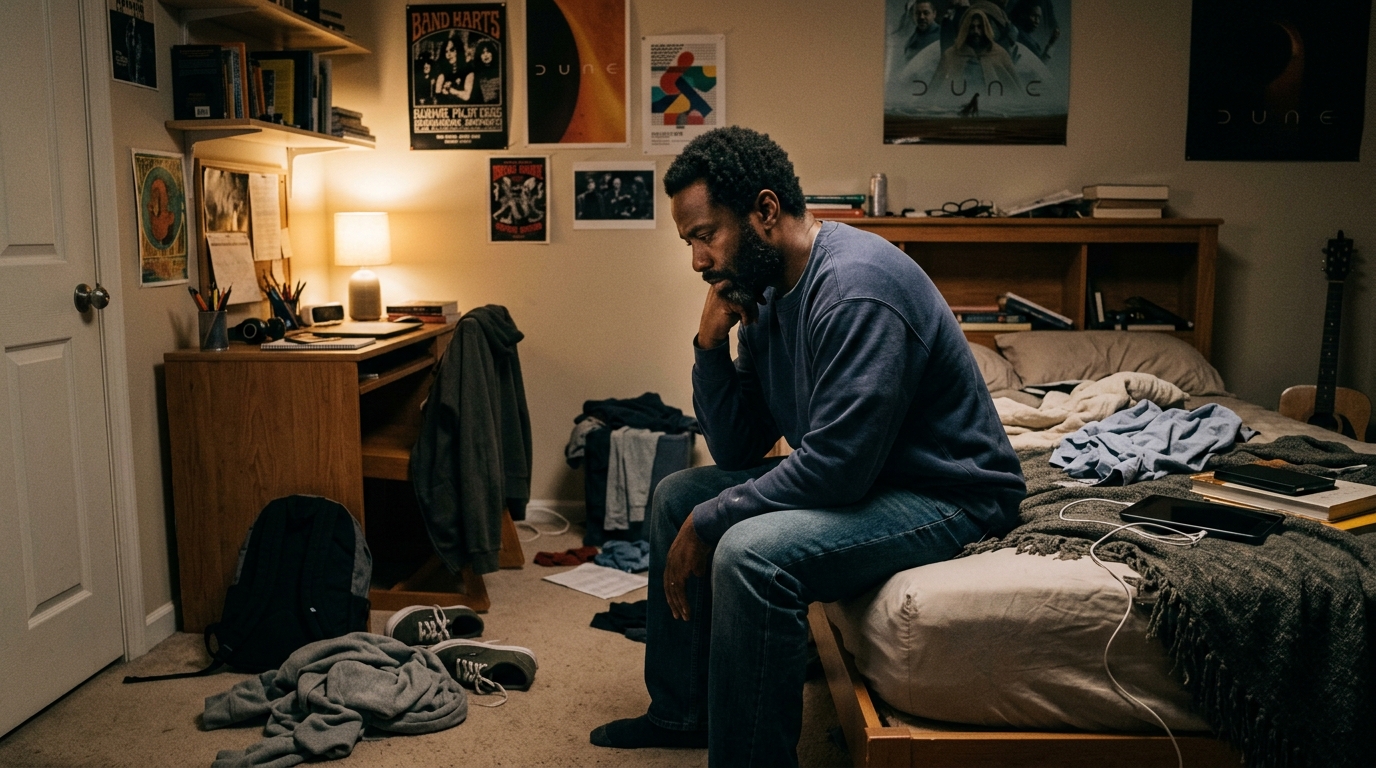
When parents describe their teenager as “out of control,” there’s usually a specific quality to how they say it. It’s not just frustration — it’s something closer to bewilderment. The kid they thought they knew has become someone unrecognizable. The rules that used to work don’t work. The conversations that used to resolve things now end in slammed doors or silence or screaming. And underneath all of it: a low-grade terror that something is very wrong and they don’t know what to do about it.
If you’re in that place, I want you to know: what you’re feeling makes complete sense. And I also want to offer you a reframe that might be the most useful thing in this article.
“Out of control” is your experience, not a diagnosis. It’s a description of how things feel from the outside. And the behavior that feels chaotic and incomprehensible from where you’re standing almost always makes perfect sense from inside your teenager’s world.
Understanding that doesn’t fix anything immediately. But it opens a door that fear keeps closed — and behind that door is the path forward.
What “Out of Control” Actually Means
Here’s what I’ve learned from years of sitting with teenagers in crisis and the parents who love them: teenagers don’t usually “go out of control.” They respond to something — and the response, unmanaged and unaddressed, escalates until the parent experience crosses the threshold from “concerning” to “out of control.”
That escalation has its own logic. And it almost always started somewhere specific.
Not always with something dramatic. Sometimes it starts with a social humiliation at school. A friendship that fell apart. A sense of failing academically when they’d always succeeded. A family change — divorce, a move, the loss of a grandparent — that no one fully processed together. An identity question — about sexuality, about belonging, about who they are — that they’re carrying completely alone.
The behavior that alarms you is the surface. Beneath it, something is usually happening that your teenager doesn’t yet have the tools, the language, or the safety to communicate directly. That’s not an excuse. But it’s important context.
The Behaviors That Alarm Parents Most
Different families hit their limit at different behaviors. But the ones that most reliably send parents searching for help tend to cluster around a few themes:
Defiance and aggression: Refusing to follow any household rules. Explosive outbursts — verbal aggression, property destruction, occasionally physical. The rules that used to hold simply don’t anymore.
School refusal and failure: Refusing to go to school, or attending but not engaging. Failing grades despite evident intelligence. A complete withdrawal from academic effort.
Substance use: Marijuana, alcohol, or other substances — sometimes as self-medication, sometimes as social belonging, sometimes as a way to numb something they don’t know how to carry otherwise.
Withdrawal and disappearance: The teenager who has gone behind a closed door and hasn’t really come out. Stopped participating in family life. New friend group the parents don’t know. Drastic changes in sleep, appetite, appearance.
Dangerous behavior: Risky sexual behavior, reckless driving, self-harm, running away, online behavior that creates real-world risk. This is the category where the stakes are highest and the window for intervention is narrowest.
One or two of these, depending on intensity, may still be in the range of “challenging normal.” Several together, or any one of them at high intensity over a sustained period, is a signal that something beyond normal adolescent turbulence is happening.
What the Behavior Is Usually Telling You
This is the part most parents skip — because it’s hard to get curious when you’re scared or exhausted or you’ve just been screamed at.
But if you can create even a little distance from the behavior and ask what is this telling me?, some patterns emerge.
1 “I need more autonomy than I’m getting”
Adolescence is fundamentally about the developmental task of individuation — becoming a self separate from parents. Defiance that spikes right around this developmental phase often signals that the balance of control and autonomy in the household is off. The teenager is pushing for independence the only way they know how.
2 “I’m in pain and I don’t know how to say it”
Acting out is often acted-in turned inside out. A teenager who is struggling with depression, anxiety, shame, or trauma will sometimes externalize it — because anger is easier to feel than grief, and fighting is easier than falling apart. The aggression on the surface may be covering profound hurt underneath.
3 “I need connection and I’m not getting it”
This one is counterintuitive. Teenagers who are behaving in ways that push parents away are often doing so because they have a deep, unmet need for connection — and they don’t know how to ask for it, or they’ve given up on it being available. The behavior creates distance; the need underneath it craves closeness.
4 “Something happened that I haven’t told you about”
Sometimes the behavioral shift has a specific trigger — a trauma, a betrayal, an experience of victimization — that the teenager is carrying alone. They haven’t told you because they’re ashamed, or they don’t think you’ll believe them, or they don’t have the words. The behavior is the leak.
None of this means the behavior is acceptable. It means that addressing only the behavior, without addressing what’s underneath it, tends to produce compliance without healing — or, more often, simply doesn’t work at all.
What Doesn’t Work (And Why)
Most parents, when things escalate, default to one of two responses: they tighten the controls or they give up entirely. Neither works well.
Punishment escalation: More consequences, stricter rules, increased monitoring. This can produce short-term compliance in some teenagers. In others — and especially in those who are already dysregulated — it escalates the conflict rather than containing it. A teenager in crisis doesn’t respond to increased pressure the way a healthy nervous system does.
Permissiveness from exhaustion: At some point, many parents simply stop fighting. They stop enforcing limits because every limit creates a battle and they’re out of fuel. The problem: teenagers without limits often feel less safe, not more. The limits tell them someone is paying attention, someone cares enough to hold the line. When those disappear, anxiety tends to increase, and behavior often worsens.
Reasoning and lecturing: You cannot talk a dysregulated teenager into regulation. The part of the brain that does logical reasoning is not fully accessible when the nervous system is activated. Long explanations of consequences, appeals to future outcomes, carefully structured arguments about why the behavior is problematic — these almost never work in the moment. They may have value later, in a calm moment, but not during the crisis.
Hoping it passes: Sometimes it does. But sometimes it doesn’t, and waiting costs real time and real development. If the behavior has been going on for more than a few months and shows no signs of shifting, waiting is not a strategy.
A Framework for Deciding What to Do
Not every situation requires the same response. Here’s a rough framework for thinking about what level of intervention fits what you’re actually dealing with:
The behavior is concerning but not dangerous. There’s still meaningful communication possible. Try: changing how you engage (less lecturing, more listening), renegotiating the balance of autonomy and limits, getting curious about what’s driving the behavior, and identifying one or two changes in your own approach that might shift the dynamic. Parent coaching can be invaluable here — not because something is wrong with you, but because these situations benefit from an outside perspective.
Home-based adjustments haven’t moved things, or the severity warrants outside support from the start. Therapy for the teenager (individual, family, or both), ongoing parent coaching, and possibly therapeutic mentoring that provides a consistent, trusted adult presence outside the family. The teenager is still able to function in their home and community, even if struggling.
The situation has moved into territory that outpaces what outpatient support can address. There’s active danger — to the teenager or to others. The teenager can no longer safely remain in the current environment. At this level, options include live-in mentoring, intensive outpatient programs, or residential treatment. This decision deserves a professional assessment — not a panicked choice made in the middle of a crisis.
The right level of intervention is the one that actually matches the situation — not the most dramatic available, not the least uncomfortable. Getting that calibration right matters.
Getting the Right Support
Here’s what I’ve learned: most parents of teenagers in crisis wait too long. They hope the situation will resolve on its own. They worry about what getting help means — about labeling their teenager, about whether the intervention will make things worse, about cost and logistics and what people will think.
Meanwhile, the situation continues. And the longer it continues, the more entrenched the patterns become and the more ground has to be recovered.
Getting support is not an admission of failure. It’s a recognition that some situations genuinely require more than a family can provide on its own — and that getting that support sooner rather than later is almost always better.
If you’re not sure what level of support is appropriate, or what type, that’s actually a good starting point for a conversation with someone who can help you assess. Not to hand off the problem — but to get clear-eyed about what’s actually going on and what the real options are.
If you’ve been noticing signs that your teen needs more than therapy, that’s worth taking seriously. Not every situation can be resolved in a weekly therapy session. Some require a more comprehensive, more consistent presence in a teenager’s actual life.
A final word for parents in the middle of it
You did not cause this by failing. You are not powerless to help. The relationship you have with your teenager — even when it feels completely broken — is still the most significant factor in their recovery and growth. Protecting that relationship, even when it means backing off from battles that don’t need to be fought right now, is not weakness. It’s strategy. Stay in contact. Keep the door open. And get the support your family actually needs.
About the Author
James Farmer
James Farmer is the founder of Noble Mentors, a therapeutic mentoring organization along Colorado’s Front Range. With over 15 years of experience mentoring teens and young adults through pivotal transitions, James trains and supervises a team of mentors committed to transformation through genuine relationship. He believes that real growth happens not in an office, but in the actual terrain of a young person’s life.
Read Next
Am I Enabling My Adult Child? How to Tell the Difference
You’ve probably typed some version of this question into a […]