


FOR FAMILIES LIVING AROUND THE RITUALS, THE CHECKING, AND THE QUESTIONS THAT NEVER SETTLE
Therapy maps the way out of OCD.
We walk it with them.
Exposure and response prevention (ERP) is the most effective treatment there is for OCD — and it works best where OCD actually lives: the kitchen, the car, the grocery store, the front door. Noble Mentors pairs your son or daughter with a mentor trained in ERP and CBT who practices the hard things with them, in real life, in step with their therapist.
15 Years
of mentoring young people
300+
families served
7 Days
or less, from your call to a first session
We mentor teens and young adults across Boulder, Denver, and the Colorado Front Range.
The first step is a free 40-minute consultation call — no pressure, no diagnosis, no obligation. If we are not the right fit, we will point you to who is.
YOU MIGHT BE SEEING
What OCD can look like at home
✓Showers, handwashing, or bedtime routines that swallow an hour — and fall apart if interrupted
✓Checking and rechecking — locks, stoves, homework, texts — long past reasonable
✓The same question asked again and again: “Are you sure? But are you sure?”
✓Foods, rooms, door handles, or whole places quietly dropped from life
✓Redoing things until they feel “just right” — rewriting, re-walking, re-saying
✓Hours lost to invisible rituals — counting, praying, reviewing conversations, neutralizing thoughts (sometimes called “Pure O”)
✓Intense fear of harming someone, being contaminated, or being a bad person — despite no evidence
✓Scrupulosity: moral or religious fear far beyond belief or values
✓Rage or panic when the family stops playing along with the rules
✓A bright, capable young person who knows it does not make sense — and cannot stop
If some of these fit, you are not imagining it — and it is more common than you think. More than two-thirds of people cannot accurately identify OCD when they see it (International OCD Foundation).
Name it with someone who knows the territory — schedule a free consultation call →
HOW IT WORKS ON THEM — AND HOW IT STOPS
The loop is the illness. Breaking it is the treatment.
An intrusive thought lands. The alarm floods in. A ritual — washing, checking, asking, mentally reviewing — buys a minute of relief. And that minute of relief is exactly what teaches the brain to run the loop again, harder. OCD is not a logic problem. It is a loop problem.
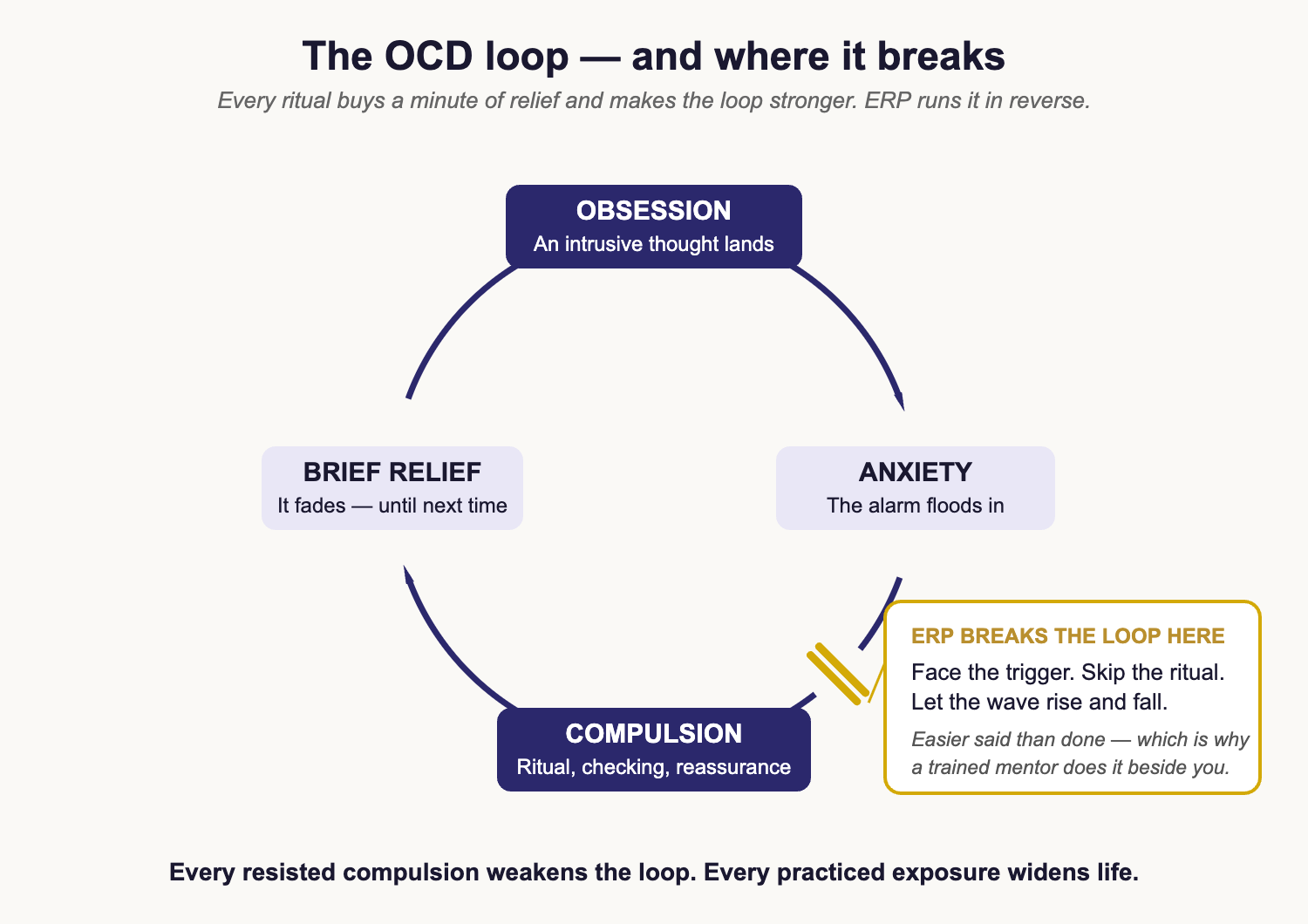
Exposure and response prevention breaks the loop at its hinge: face the trigger, skip the ritual, and let the anxiety rise and fall on its own. The International OCD Foundation calls ERP “the proven, most effective, first-line therapy for OCD in adults, children, and adolescents.” The catch: it only works if it gets practiced — over and over, in the exact places OCD lives.
WHY MENTORING FITS OCD SO WELL
ERP lives or dies between appointments
One hour a week of therapy. A mentor for the rest of real life.
THE NOBLE MENTORS APPROACH
How our OCD support for teens and young adults works
WHAT THIS LOOKS LIKE IN PRACTICE
One week of breaking the loop
Every plan is built around one young person, one hierarchy, one pace. But an ordinary week can look like this:
Therapy session
The therapist reviews last week, moves one rung up the exposure ladder, and sets the practice targets.
Mentor session — the grocery store
Mentor and client walk the feared aisle, touch the cart, buy the “contaminated” item. The wave rises. They stay. It falls.
Short check-in
A text after solo practice: did the recheck get resisted? What number did the anxiety hit, and how fast did it drop?
Mentor session — the kitchen
Cooking dinner with the pans that have been off-limits for a year. No gloves. No redo. Dinner gets eaten.
Four touchpoints. Zero white-knuckling alone. The office plan, alive in the real week.

THE RESEARCH
The evidence is unusually clear
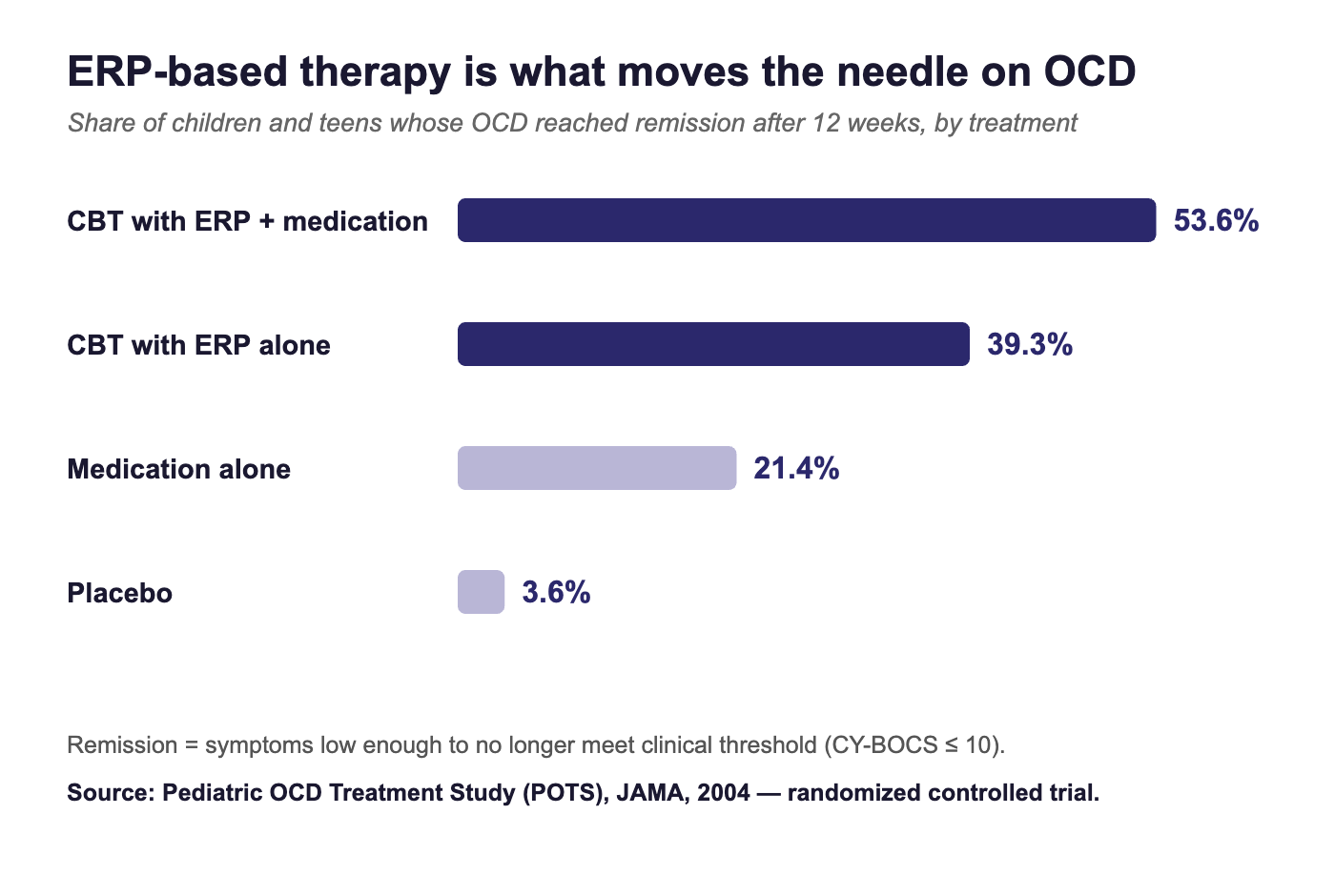
In the landmark Pediatric OCD Treatment Study, more than half of children and teens who received ERP-based CBT combined with medication reached remission in twelve weeks — and ERP-based CBT alone outperformed medication alone. Placebo barely moved.
The treatment works. What most families are missing is not a better therapy — it is enough support to actually do the therapy’s hardest part, out in real life, all week long.
Put real support around the evidence — schedule a free consultation call →
If OCD is in your house, you are in very large company.
1 in 40
adults in the United States currently have OCD
International OCD Foundation
2.2 million
children in the U.S. are living with OCD
International OCD Foundation
7+ years
on average from first symptoms to an accurate diagnosis
International OCD Foundation
Seven years is the average. It does not have to be yours.
IF LOVE AND LOGIC WERE ENOUGH, YOU WOULD BE DONE BY NOW
Why trying harder has not fixed it
They usually know it does not make sense
Most young people with OCD can tell you the fear is irrational. Insight does not stop the loop — that is what makes OCD so demoralizing, and so misunderstood.
Reassurance is a compulsion wearing a kind face
Every “you are fine, I promise” buys a minute of calm and strengthens the loop — the same trade the rituals make.
Avoidance rents relief and charges interest
Every skipped aisle, dropped food, and avoided room makes the world safer-feeling and smaller. The loop collects either way.
White-knuckling alone rarely holds
Exposure without support usually ends in escape — which teaches the brain the fear was right. Supported exposure teaches the opposite.
A FEW MONTHS IN
What families usually notice first
✓The shower is twenty minutes, not ninety
✓A feared food is back on the plate; a closed-off room is back in the house
✓“Are you sure?” drops from thirty times a day toward a handful
✓ERP homework actually happens between therapy sessions — and the therapist notices
✓Dinner conversation is about life again, not the rules
✓The world gets bigger: friends, driving, work, school — reclaimed one exposure at a time
THE TEAM
Mentors who meet them where they are

James

Joe
Colin

Isaiah

Kristin

Jake

Jazmine

Andrew

Felice
Adam


Erica

Elan