There’s a particular kind of misery that comes from sitting in front of something you know you need to do — and not doing it.
The document open on your screen. The assignment you’ve been avoiding for three days. The conversation you keep rehearsing but never have. The future you want to build, waiting while you scroll.
You’re not lazy. If you were, you wouldn’t feel the weight of it.
It’s 9 PM on a Sunday. You have a college application essay due in the morning — a prompt you’ve known about for six weeks.
You open the doc. You type your name. You stare at it. You close the tab and open YouTube.
An hour later you’re watching a video about people who build cabins in the woods, and something in you is both completely numb and quietly falling apart.
You know what you’re doing. You can’t stop doing it. And the shame of that gap — between knowing and doing — feels worse, somehow, than the essay itself.
This is procrastination in young adults: not indifference, but paralysis wearing indifference as a mask.
The War Is Already Happening
Procrastination gets framed as a failure of discipline. You need more willpower, better habits, a tighter schedule.
But that framing misses what’s actually going on.
When a young man sits frozen in front of his homework — or games for six hours instead of applying for the job, or says tomorrow, definitely tomorrow for the fourteenth time — there’s a war happening inside him.
One part knows what needs to happen. Has probably rehearsed it mentally a dozen times. Can articulate exactly why it matters.
Another part will not move.
Understanding why that second part exists — and what it’s actually protecting you from — is where real change begins.
What the Avoidance Is Doing
Avoidance is never random. It’s always protecting against something.
For some people, it’s protecting against failure. If you never fully try, you can never fully fail. The project left half-done preserves the possibility that you could have done it well.
For others, it’s protecting against the feeling of incompetence. Starting means discovering that you don’t know how — and that discovery is more threatening than the undone task.
For others still, it’s the sheer weight of beginning. The task is so large, so undefined, that the mind refuses to enter it. There’s no obvious door in, so it doesn’t go.
And for some, avoidance is a way of maintaining control in a life that otherwise feels controlled by others — school schedules, parent expectations, social demands. This thing I don’t do because I choose not to. The refusal is the last bit of autonomy.
None of these are character flaws. They’re adaptations. They made sense somewhere, for some reason. The problem is they’ve stopped serving you.
The Three-Part Trap
Most chronic procrastinators live inside the same cycle:
- The anticipation. The thing sits on the horizon. You think about it. It feels worse the longer it sits. You avoid thinking about it, which requires energy, which depletes you.
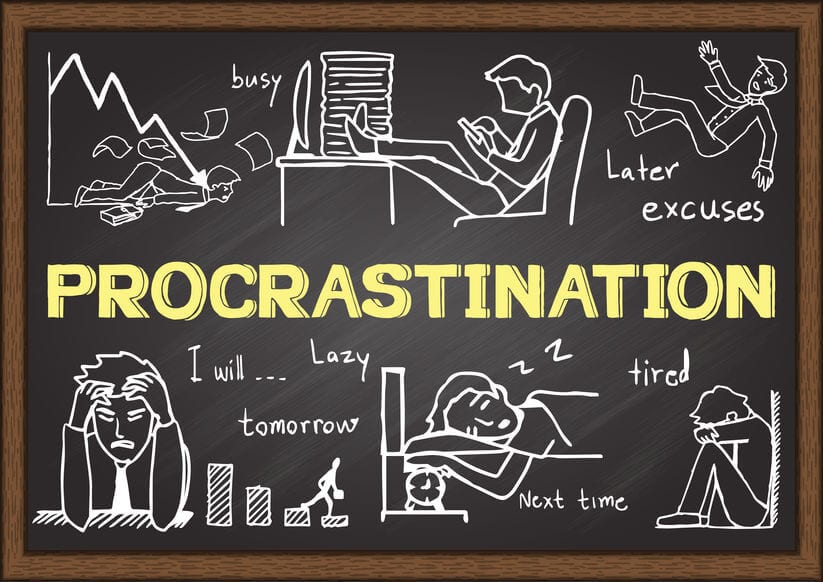
- The avoidance. You do something else — something easier, more pleasurable, more certain. Gaming. Scrolling. Reorganizing your desk for the third time. This provides relief, temporarily.
- The shame. The temporary relief turns. The thing is still there. Now there’s less time, more pressure, and a layer of self-judgment on top. What’s wrong with me? The shame makes the task feel worse. Which makes avoidance more appealing. Back to the top.
It’s a loop. And loops can be interrupted.
When It’s More Than Willpower
The Wiring Problem
Here’s something that doesn’t get said enough: for some people, procrastination in young adults isn’t primarily a motivation problem. It’s a wiring problem.
Executive function — the set of cognitive skills that governs planning, initiating tasks, managing time, and regulating emotion — develops at different rates in different people.
For some young adults, these systems are genuinely less developed, or function differently, than in their peers. This is especially true for those with ADHD, anxiety, or certain learning profiles — though you don’t need a diagnosis for any of this to be true of you.
When people ask why can’t I start anything, they’re often asking a deeper question: Is something wrong with me?
Nothing is wrong with you. But your brain may be working harder than most to do what others seem to do effortlessly. The gap between intention and action that everyone experiences occasionally can, for some people, feel like a wall — every single time.
Why Pressure Makes It Worse
Executive function in young adults is not a fixed quantity. It can be supported, scaffolded, and developed — but not by shaming the person who’s struggling with it.
Pressure and criticism often make executive function worse, not better. The nervous system under threat contracts. The part of the brain responsible for planning and decision-making goes offline.
This is why “just try harder” fails. And why having the right kind of support — structured, steady, non-judgmental — can change the entire equation.
Not because someone is doing the work for you. But because the right relational container actually gives your nervous system permission to engage.
If any of this sounds familiar — if you find yourself starting a hundred times and stopping, if time feels impossible to manage, if you know what you need to do and cannot seem to move — you’re not broken. You may simply need a different kind of support than you’ve been offered so far.
Starting Isn’t About Motivation
Here’s the thing that changes everything when a young person really hears it:
You don’t wait for motivation to start. You start, and then motivation shows up.
The brain generates motivation by engaging with a task, not before. This is neurologically true. The dopamine that makes effort feel meaningful gets released as you work — not as you sit thinking about working.
This is why “just start” is actually good advice, when it comes with the understanding that starting doesn’t require feeling ready, wanting to, or believing you can finish.
You need to start small enough that refusal feels ridiculous.
Five minutes. One paragraph. Open the document and write a single sentence — even a bad one.
The nervous system learns by doing, not by preparing to do.
What Mentoring Actually Changes
In my work with young people, I’ve watched what happens when someone finally has someone beside them who holds the task without shaming them for not completing it.
Not a parent who’s frustrated. Not a teacher watching the clock. Not an inner critic cataloging every minute wasted.
Just another person, steady, present, who says: Okay. Let’s start. What’s the smallest possible piece?
And they start. Not because the fear disappeared — but because the shame weight got lighter.
If the war against starting is playing out in a slipping semester — missed assignments, a GPA in freefall, or a young adult who cannot begin the job search — that is exactly the territory of our academic and career coaching for young adults. A mentor helps build the structure first; the starting follows.
Removing the Shame
Procrastination often has shame as its engine. Shame says: you are the problem. And when you believe you’re the problem, you avoid the evidence. Which means avoiding the task.
Taking the shame out of the room changes the equation. The task doesn’t feel like an indictment anymore. It’s just a task.
And when the thing being avoided is people themselves — invitations declined, calls unanswered, a world quietly shrinking — that is its own pattern with its own way out. We wrote about it here: social anxiety and isolation support for young adults.
The Moment of Initiation
Real mentoring goes further than accountability check-ins or to-do list reviews. It means someone being present with you in the moment of initiation — the hardest moment, the one most people face alone.
A mentor can sit with you while you open the document. Can help you name what feels impossible about it. Can witness the first small step without making it a big deal.
Over time, that external scaffold becomes internal. You start to trust that you can begin — not because someone told you that you could, but because you’ve done it enough times, with enough support, that your nervous system remembers.
For young adults navigating what’s sometimes called failure to launch — where the momentum into adult life feels genuinely stuck — this kind of grounded, relational support is often what’s been missing all along.
Not harder pushing. Not more structure imposed from outside. But a real relationship, with someone who’s been through the threshold and can stand with you while you approach your own.
For Parents
If you have a teenager or young adult in your life who seems paralyzed — who plays games for hours instead of doing homework, who can’t seem to start anything, who insists he’ll do it later until later becomes never — resist the urge to interpret this as laziness or defiance.
Ask what the task means to him. What failing at it would mean. What he’s been telling himself about why he can’t do it.
You might be surprised.
The war that looks like laziness from the outside is often quite loud on the inside.
And the young person who looks like he doesn’t care often cares so much that caring feels dangerous.
A Question Worth Sitting With
Is there something you’ve been avoiding that you actually want?
Not something imposed on you — but something that’s genuinely yours, that matters to you, that you keep not starting?
What are you protecting yourself from by not beginning?
That’s the conversation worth having. Not with a to-do list. With someone who can help you look at it without it becoming an indictment.
Procrastination in young adults rarely resolves on its own — not because the person lacks potential, but because the loop is hard to interrupt alone.
At Noble Mentors, we work with teens and young adults navigating exactly this: the gap between knowing what matters and actually moving toward it. Real-world mentoring. Steady relationship. No shame.
If you’re watching someone you love get stuck at the threshold — or if you’re the one who can’t seem to start — we’d be glad to talk. Learn more about our work with young adults who are struggling to launch at noblementors.com/failure-to-launch.
Noble Mentors serves teens and young adults along Colorado’s Front Range. Our mentors work in the real world — not just the office — because that’s where real change happens.
Noble Mentors
Real help for this exact struggle
If this article hits close to home, our Executive Function Coaching page shows exactly how we walk alongside families like yours. Or see how the whole mentoring journey unfolds — The 7 Stages of Noble Mentoring.