

If you’ve ever navigated through wilderness with a map and compass, you know the secret: you don’t hike with your face buried in the map.
You stop. You shoot a bearing. You find a prominent feature on the horizon — a rock formation, a ridgeline. You put the map away and walk toward it, fully present to the terrain underfoot. When you arrive, you stop again, pull out the map, and set the next bearing.
That’s exactly how a North Star Vision becomes a life.
In a previous article, we walked through the process of clarifying your North Star Vision — that far-off point on the horizon that orients everything. Now comes the harder question: how do you actually walk toward it?
This is where most goal setting for young adults goes wrong. Not because the person is lazy. Not because the dream isn’t real. But because no one ever taught them to put the map away and walk.
Why Goals Fail Without the Right Foundation
Here’s a pattern I see all the time in the young people I work with: they set goals at the wrong layer.
They aim at outcomes — lose ten pounds, get the job, save the money — without addressing what actually makes change stick. Imagine three concentric circles. The outer ring is the outcome — what you want to achieve. Inside that is the process — the habits and actions that will produce the outcome. And at the core, often untouched, is identity — who you’re becoming.
Most goal-setting advice lives in the outer ring. It gives you a target and a to-do list and calls it a plan.
But if you want to lose ten pounds and build the habits to get there, and you still fundamentally see yourself as someone who is unhealthy and undisciplined — the habits won’t hold. Goals pursued without touching the inner layer tend to circle back to the same starting point. You haven’t changed the story you tell about who you are.
Real change requires all three layers: what you’re aiming at, how you’ll get there, and who you’re becoming in the process. Keep that in mind as we build the framework.
SMART Goals: The Compass That Keeps You Honest
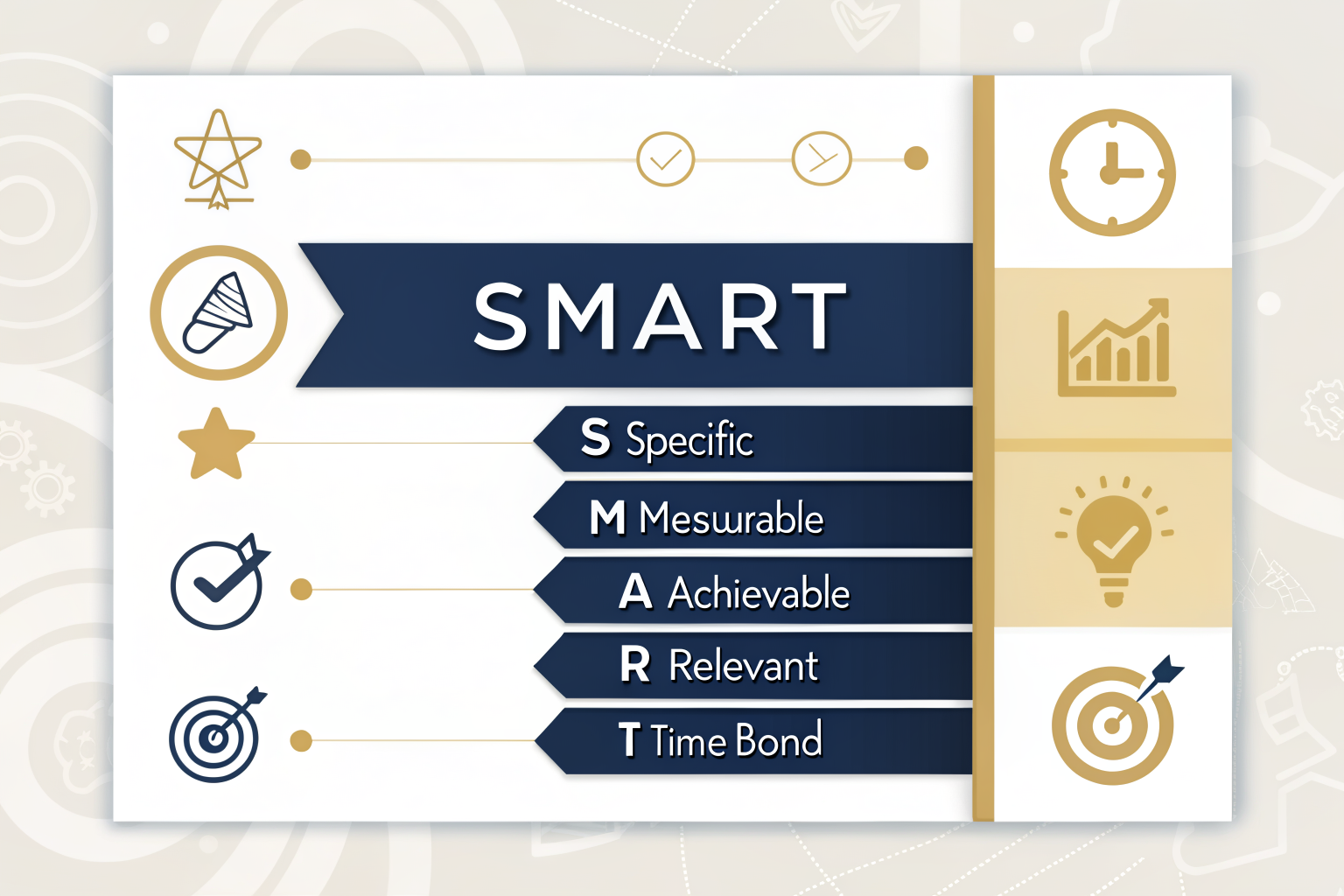
There’s a reason the SMART framework has been around for decades. It works — not as a corporate productivity hack, but as an act of self-honesty. Think of it as a compass for your goals. Each letter checks something real.
Specific
Vague goals are easy to ignore and impossible to honor. If you can’t describe exactly what success looks like, you’ll fool yourself in both directions — believing you’ve arrived when you haven’t, or missing progress entirely. Make it sharp. What am I aiming at? What does success look like? How will I know if I’m falling behind?
Measurable
Your brain is actually wired to find meaning in the pursuit of a goal — not just reaching it. When you track progress, you activate something deeper: motivation that doesn’t depend on willpower. Make your goal measurable and you give yourself a way to stay engaged with the journey. How will I know when I’ve arrived? How much, how long, how many?
Achievable
There’s a principle worth naming here — the Goldilocks Rule. Humans thrive when challenge is calibrated just right. Too easy and the goal loses its pull. Too hard and repeated failure will eventually grind you down. Boredom is as dangerous as overwhelm. Find the zone that’s neither comfortable nor crushing, and honor your own capacity to grow into it.
Relevant
A goal that doesn’t connect to the life you’re actually trying to build is a goal without voltage. Most people aren’t lazy — they’re uninspired. Irrelevant goals feel like obligations, not directions. The right goals align with your North Star Vision and your values. They feel alive, not assigned.
Time-Bound
Deadlines are a gift, not a punishment. Without them, most goals drift indefinitely — not because you don’t care, but because the human mind will always find something more urgent to tend to. Set a deadline. Even a soft one. It introduces healthy pressure into the system.
Two Things SMART Doesn’t Cover
The SMART framework is solid. But it starts in the middle of the story. There are two things that need to happen before you set your first goal — and most goal-setting guides skip right over them.
Start with acceptance
When you’re navigating wilderness with a compass, the very first step isn’t setting a bearing. It’s locating yourself on the map. You have to know where you are before any bearing makes sense.
The same is true with goals.
Acceptance doesn’t mean being content with where you are. It means being honest about it. Denial doesn’t build a map. It just makes you more lost. If you’re not where you want to be financially, relationally, emotionally — acknowledge it without cruelty, but with clarity. The plan you build from that honest ground will actually work. Goals built on wishful thinking about your starting point will loop you back to the same place.
Be honest. Be kind with yourself. Then build.
Link your goals to identity, not just achievement
Here’s what I’ve come to believe after years of sitting with young people in real-world transition: the outer symbols of any success — the money, the status, the body — are fragile. They can be lost. What can’t be taken from you is who you’ve become in the process of pursuing them.
This matters for goal-setting because it changes your orientation entirely.
Can you feel the difference between I want to learn to play music and I want to be a musician? Between I want to be successful and I want to become a person of character and integrity? The second framing reaches into something deeper. It connects your daily actions to your evolving identity.
Each action becomes a vote for the person you’re seeking to become. And when it works that way — when the small and the large are genuinely linked — the mundane tasks of the day carry the motivation of the bigger picture. Going to the gym isn’t a chore. It’s an expression of who you’re becoming.
How to Break Down Your Goals: From Vision to This Week
Now for the practical cascade — this is where “turning vision into action” becomes something you can actually do on a Tuesday morning.
The question most people ask is: how do I not get overwhelmed by how big this is?
The old answer is still the right one. How do you eat an elephant? One bite at a time.
Start with your North Star Vision. It’s the bearing — the distant terrain feature you’re walking toward. From there:
Step 1 — Quarterly Projects. Look at your NSV and identify three milestones you could realistically hit in the next three months. Keep this list small — no more than five. Focused energy builds more momentum than scattered effort. Write each one in the present tense, as if it’s already done: I’ve completed… I’ve started… I’ve stopped…
Step 2 — Weekly Goals. Each week, come back to your Quarterly Projects and ask: What can I do this week that moves me toward these? Set a specific, measurable, time-bound goal for the week. One. Maybe two. Something you can actually finish.
Step 3 — Put it in your calendar. This is where most people drop the ball. A goal that lives only in your head isn’t a plan — it’s a wish. Translate your weekly goal into a specific time on a specific day. When it’s on the calendar, it has a body.
One more thing worth knowing: as you map out your tasks, look for common actions — steps that advance multiple areas of your vision at once. Prioritize those. They’re high-leverage.
When you approach your North Star Vision this way — NSV to Quarterly Projects to Weekly Goals to Calendar — you’ve cut the elephant into something you can actually swallow this week. You stay connected to the future without being paralyzed by it.
Vision without goals is just daydreaming. Goals without identity are just tasks. But all three layers together — that’s navigation.
Ready to Build Your Map?
Goal setting sounds straightforward on paper. In real life, it’s harder — because life gets loud, old patterns resurface, and what feels like a clear bearing one week can feel completely lost the next.
That’s exactly what a Noble Mentors mentor walks alongside you through. Not as someone who has it all figured out, but as someone who knows the terrain and won’t let you stay lost longer than you need to.
If you’re a young adult in Colorado ready to stop drifting and start navigating toward something real, we’d love to talk.
Schedule a Free Consultation →
About the Author
James Farmer
James Farmer is the founder of Noble Mentors. He has over a decade of experience mentoring teens and young adults through wilderness therapy, residential treatment, and private practice along Colorado’s Front Range. His approach is rooted in lived experience, depth psychology, and a deep belief in the transformative power of authentic human connection.