
“The best way to find yourself is to lose yourself in service to another.” – Gandhi

Mentor Development Program
The Mentor Development Program is an advanced track for those who feel called to serve others through mentorship—whether that’s in your personal life, within your existing career, or as the beginning of a professional mentoring practice.
Mentoring doesn’t only happen in formal settings. It shows up in everyday life—between a parent and their child, a coach and an athlete, a teacher and a student, an older sibling and a younger one, or a friend who simply shows up for another in need.
No matter where or how you’re showing up as a mentor, this program is designed to help you become a more grounded, impactful, and authentic guide. Through both group work and one-on-one work with James, you’ll dive into the 7-Stage Mentoring Process, first experiencing it for yourself, then learning how to facilitate it for others.
The Mentor Development Program is an advanced track for those who feel called to serve others through mentorship—whether that’s in your personal life, within your existing career, or as the beginning of a professional mentoring practice.
Mentoring doesn’t only happen in formal settings. It shows up in everyday life—between a parent and their child, a coach and an athlete, a teacher and a student, an older sibling and a younger one, a friend who simply shows up for another in need.
No matter where or how you’re showing up as a mentor, this program is designed to help you become a more grounded, impactful, and authentic guide. Through one-on-one work with James, you’ll dive into the 7-Stage Process, first experiencing it for yourself, then learning how to facilitate it for others.
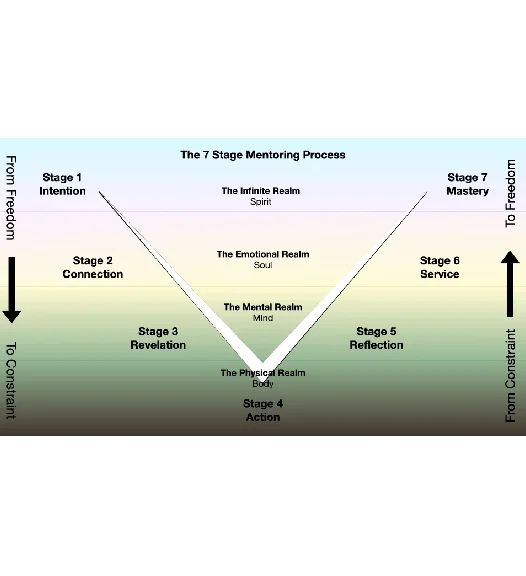
The 7 Stages of the Mentor Development Program

Stage 1: Intention
Everything begins with intention. As mentors, we first clarify why we do this work and what kind of presence we want to embody. This is more than setting goals—it’s establishing sovereignty, wholeness, and a foundation of inner alignment. In this stage, you’ll explore your own story, name your personal values, and connect with the deeper purpose that fuels you. Intention creates the compass for your practice: it steadies you when challenges arise, and it invites you to show up not just as a helper but as a guide who lives by example.

Stage 3: Revelation
Revelation is the process of bringing to light what has been hidden—patterns, fears, desires, and distorted thinking that shape a client’s life. As mentors, we use tools like the Life Review, Values Assessment, and the 12 Essential Aspects to help clients see clearly. This stage isn’t about diagnosis; it’s about curiosity and discovery. Revelation empowers clients to name what’s real for them, uncover what drives avoidance or struggle, and glimpse the North Star Vision of who they are becoming. You’ll learn to facilitate these discoveries with both courage and compassion, guiding clients through the discomfort of seeing themselves more honestly.

Stage 5: Reflection
Reflection is where meaning is made. Now that we have supported our clients in becoming more masterful in their external worlds, in Stage 5 we place greater emphasis on the internal world—helping clients become more aware and awake through meditative and contemplative practices. Here we take a deep dive into the virtues we choose to anchor our identities in, uncovering the personal ethic that will guide our lives. Reflection also deepens the mentor’s role: you become a midwife of awareness, helping clients see patterns across time, integrate lessons, and refine their sense of self. Without reflection, change remains surface-level; with it, transformation takes root.

Stage 7: Mastery
Mastery is not perfection—it is integration. This stage is about consolidating the journey, closing loops, and preparing both mentor and client for endings and new beginnings. In Mastery, mentors learn the art of closing: honoring the process, celebrating progress, and acknowledging what has been learned together.

Stage 2: Connection
Before change can happen, trust must be built. Connection is where mentoring takes root through deep listening, attunement, and presence. Here you’ll learn the art of building a genuine connection with your client, shifting from giving advice to cultivating the skills that foster true safety and openness. By exploring what gets in the way of truly seeing another, you’ll discover profound ways of entering into your clients world. Connection is about cultivating rapport that invites authentic honesty and sets the stage for deeper revelation.

Stage 4: Action
Insight without action fades. In this stage, mentors support clients in turning what they’ve discovered into tangible change. Action involves goal setting, habit formation, systems analysis, and practical structures that move a client forward. We draw on coaching skills, accountability practices, and productivity tools while staying attuned to the client’s capacity and balance. As a mentor, you’ll help clients practice new behaviors in the real world—navigating setbacks, testing routines, and aligning daily choices with their deeper vision. Action is where momentum builds, and it often requires both encouragement and disruption to keep growth alive.

Stage 6: Service
This stage is about guiding clients beyond independence into interdependence—where greater accountability is required and deeper intimacy becomes possible. In Stage 6 we explore how mentors work with family systems and become effective parent coaches. We will also explore the skills and capacities needed to effectively lead groups and become sensitive to the dynamics of the group field. Clients learn that freedom is earned through responsibility, integrity, and service, and mentors learn to model and facilitate this shift from self-centered growth to meaningful contribution.
The 7 Stages of the Mentor Development Program
Stage 1: Intention
We begin by setting the foundation. You’ll explore the core principles of mentoring and define your personal intention for stepping into the role of a Noble Mentor. Purpose sets the tone for everything that follows.
Stage 2: Connection
Mentoring starts with trust. You’ll learn how to cultivate connection through deep listening, effective communication, and authentic presence. Building rapport is what makes the deeper work possible.
Stage 3: Revelation
Using the 12 Essential Aspects, you’ll learn to identify what’s working—and what isn’t. We’ll explore how to support others through patterns like anxiety, depression, addiction, and distorted thinking. This stage helps mentors get to the root of what truly needs attention and healing, and culminates in co-creating a vision for the future.
Stage 4: The Turn
Now we translate insight into action. You’ll work with tools for goal setting, habit formation, time management, and real-world application. This is where change begins to take shape.

Stage 5: Reflection
Here, we dive deeper into self-awareness. Through practices that cultivate “the Witness,” you’ll learn to reflect on your experience, find meaning in success and failure, and start to live from a place of aligned values and personal ethics.
Stage 6: Service
This is a turning point. Once we’ve done the personal work, growth continues through service to others. You’ll learn the subtle art of holding space and guiding others through their own transformations. We’ll also explore how to work within family systems and how the mentor/mentee dynamic evolves over time.
Stage 7: Mastery
We close the journey by exploring transitions—both endings and beginnings. We zoom out to see the larger context of your work and your life, anchoring you in purpose and preparing you to mentor from a place of wisdom and wholeness.
Who Is This Program For?
This program is for people who feel the call to serve—and to serve well.
- For natural mentors—parents, teachers, leaders, siblings, peers—who find themselves influencing others and want to do so with more skill and depth.
- For those who see value in intentional relationships and want to be a meaningful presence in someone else’s growth.
- For individuals willing to face life’s challenges and transform both victories and failures into humility, insight, and compassion.
- For those who crave excellence—not by outside standards, but by their own inner compass of integrity, purpose, and truth.
- For people who want their lives to be about more than just themselves—who want to give back, uplift others, and make a difference in their families, communities, and beyond.


Who This Program Is Not For
This isn’t for everyone—and that’s okay. We want you to be ready for this kind of work.
- This is not a shortcut or a collection of quick “life hacks.” It’s deep work that takes commitment, courage, and consistency.
- This is not for passive learners. If you’re just looking to collect ideas without applying them in your life, this program won’t serve you.
- This is not a path to profit or ego. If you’re here to build a brand, boost your image, or make fast money, this isn’t the place.
- This requires emotional and practical independence. If you’re still working on developing personal stability—emotionally, financially, or relationally—we recommend starting with one of our Mentoring program before moving into this one.
The Heart of Noble Mentoring
You don’t have to have all the answers.
You do need a willingness to listen deeply, reflect honestly, and walk with strength and humility.
Mentorship at this level is a gift—to yourself, and to the world around you. If you feel that inner pull toward service and are ready to take on the responsibility that comes with it, the Mentor Development Program is here to support your next step.


