

Teens, Young Adults, and Adults 28–35
“Failure to launch” is a loaded phrase. We don’t use it to shame anyone. We use it because it’s what families are searching for when they’re watching someone they love stall out and not know how to help.
Noble Mentors works with this pattern every week. It’s one of the core needs our mentoring services are built to support.
Serving Boulder, Denver, and the Colorado Front Range. Home office: Lafayette, Colorado.
What “Failure to Launch” can look like
Sometimes it’s obvious. Sometimes it’s confusing. Often it includes some mix of:
- Living at home, withdrawn, avoiding — “stuck in the basement”
- Heavy gaming or tech use, reversed sleep schedule
- Dropping out of school, school refusal, or repeated starts and stops
- Not working, or unable to keep a job
- Low motivation, poor follow-through, executive function challenges
- Anxiety, depression, numbness, or shutdown
- Social isolation and loss of confidence
- Coping through weed, alcohol, porn, or other escape patterns
And it’s not only about living at home.
Sometimes a young adult is living outside the home but is still being fully supported by the family. Rent is covered. Bills are covered. Food is covered. On paper it looks like independence, but functionally they’re not building a life of their own.
Either way, the pattern is similar: avoidance grows, confidence shrinks, and adulthood never quite begins.


Why this happens
In our experience, failure to launch is rarely one thing. It’s usually a convergence of developmental, emotional, social, and practical factors.
Here are the most common reasons we see behind the scenes:
Lack of rites of passage and initiation into adulthood.
Many young people were never guided through a meaningful transition into responsibility, capability, and self-respect. Without that threshold, adulthood can feel vague, heavy, or even unreal.
Technology makes avoidance easy to sustain.
Gaming, scrolling, porn, and constant stimulation can become a primary coping strategy. The more life is escaped, the harder real life feels — and the confidence gap grows.
Economic pressure and delayed milestones.
Housing costs, entry-level wages, school costs, and the general cost of living make independence harder to build than it was for previous generations.
Social isolation and lost confidence.
Long stretches of withdrawal reduce “life reps.” The less someone practices work, school, relationships, and discomfort, the more intimidating re-entry becomes.
Meaning and identity collapse.
Sometimes it’s not laziness. It’s a lack of purpose, direction, or a life that feels worth building. When meaning is missing, motivation doesn’t have a place to land.
Neurodivergence and learning differences.
ADHD, executive-function challenges, autism-spectrum traits, and other learning differences can make adult demands feel confusing or unmanageable without the right scaffolding.
COVID disruption and missed developmental reps.
Many young people lost key practice in social life, school continuity, first jobs, and resilience-building during and after the pandemic. For some, the launch stalled and never restarted.
Feeling overwhelmed and under-equipped for daily life.
Executive functioning, emotional regulation, and confidence are still developing. When expectations rise faster than internal capacity, avoidance becomes the nervous system’s solution.
Family accommodation loops.
Well-intended support that becomes a trap. When parents stabilize everything—money, logistics, consequences—the young adult doesn’t need to develop internal structure. The system unconsciously reorganizes around the stuckness.
The good news is that these patterns are workable — especially when we support both the young person and the family system at the same time.
You’re not alone
This is a widespread issue, not a rare family failure.
58%
of adults ages 18–24 lived in their parental home in 2025.
U.S. Census Bureau
16%
of adults ages 25–34 lived in their parental home in 2025.
U.S. Census Bureau
17.4M
people ages 16–24 were not enrolled in school in 2024 (44.5% of that age group). Among them, unemployment was 9.7% in Oct 2024.
National Center for Education Statistics
If you feel scared, exhausted, or uncertain about what’s “right,” that makes sense. Most parents were not trained for this stage of parenting.
You don’t have to figure it out alone.
The Research
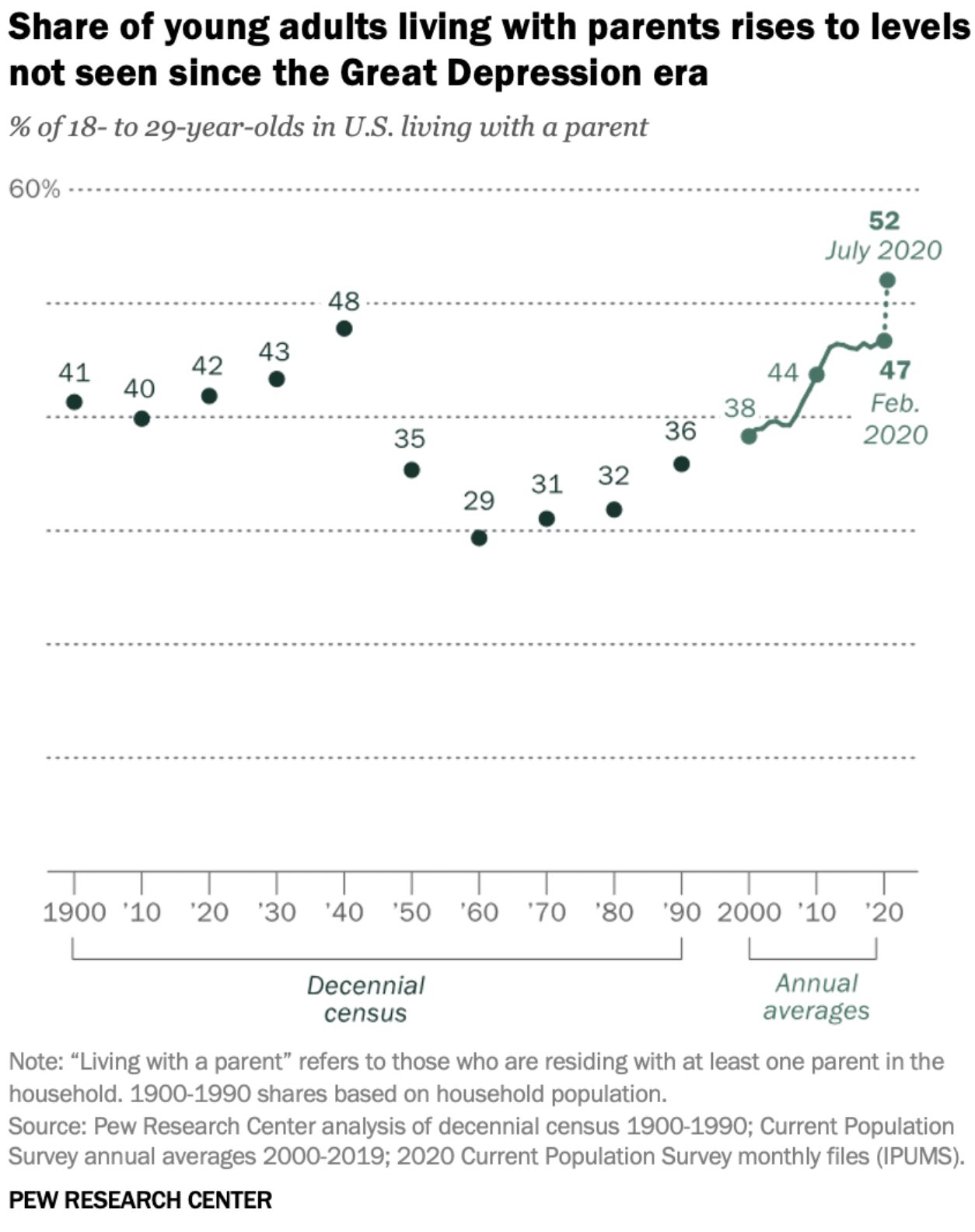
Young adults are living with parents at historic highs
52% of 18–29 year-olds were living with a parent in 2020 — levels not seen since the Great Depression. This isn’t a personal failure. It reflects structural shifts in housing, education costs, the job market, and the erosion of the social scaffolding that once supported young adult transitions.
Understanding what’s driving this pattern is the first step toward addressing it.
Source: Pew Research Center
How Noble Mentors helps
Failure to launch is a core issue that our services are designed to meet through mentoring, parent coaching, and (when needed) higher-support options.
Mentoring
The client's side of the work
Mentoring helps a young person rebuild momentum through real life — re-establishing daily rhythm, building practical accountability, executive function support, job or school re-entry, and working through avoidance patterns without shame.
The goal is not perfection. The goal is traction.
Learn more →
Parent Coaching
The family system side of the work
When a young adult is stuck, parents often get caught between over-helping and over-pressuring. We support parents in building clearer expectations, cleaner boundaries, and consistent follow-through — shifting from rescuing to guiding.
This is not about becoming harsh. It's about becoming clear.
Learn more →
Live-In Mentoring
When higher support is needed
In some situations, the daily environment has become a loop that's hard to interrupt. Live-in mentoring brings structure and real-time coaching into the places patterns actually play out: mornings, evenings, responsibilities, relationships, and routines.
If this is relevant for your situation, we'll talk through it clearly.
Learn more →
Wilderness & Rites of Passage
When it's a fit
We offer wilderness-based experiences and rites of passage work designed to help a young person step out of their default environment, face themselves with support, and reconnect with purpose, capability, and direction.
Real challenge. Real transformation. Integrated back into daily life.
Learn more →
What progress usually looks like
This isn’t usually a single breakthrough. It’s a pattern change.
- More stable rhythm and routine
- Less avoidance, more follow-through
- First steps back into work, school, or a launch plan
- Increased confidence through competence
- Reduced conflict in the home
- Parents more grounded and consistent
- A young adult beginning to take ownership again

Ready to talk?
If this page describes your situation, we should talk.


